by Gary Williams | Nov 9, 2023 | Blog
 If you’re told something enough times, you’ll likely to start believing it even if it may reside far from the truth. Behaviors and attitudes are galvanized from perceptions and shifting the momentum of firmly entrenched beliefs is an arduous task. Golf, as an overarching experience, is rooted in many things that appear far less than appealing. Exclusionary, unpliable, stuffy, snobbish, and hard. There are some who would and have signed up for the ride based on those ‘earned” labels and hopefully most of them, from a bygone era, are long gone. There are still those who inhabit the golf ecosystem who feel most comfortable when the environment reeks of the stench of discomfort. They hold on to the rigidity of club bylaws and societal norms that would suggest they sleep in tweed and think 15 minutes at the pool on Caddy Day is too long. However, there is light that has seeped through the crack in the mahogany door of golf. It looks like fun, feels inclusionary and has an ease and comfort rarely felt around the game. And whether it is a result of a sense of obligation or a couple generations of golfers deciding enough was enough, what is happening is beyond encouraging.
All the progressive and forward-thinking momentum is most evident at the 72-acre fun factory in South Pittsburg, Tennessee known as Sweetens Cove. My sentiments are not revelatory because many smart and influential voices in the game have trumpeted the aura and mindset of Sweetens long before I stepped foot there as I did last Monday. Andy Johnson and the Fried Egg was an early adopter and the “No Laying Up” boys were so smitten they bought a house across the street from the first fairway and the club has even constructed a tee on their front yard that allows shots to be played to the first green from roughly 110 yards away. Don’t misinterpret me sharing that they have a house there as an indicator that there are others. There are none, and theirs is almost a happy accident. Sweetens Cove’s collective ownership have all seen the finest things the game has to offer but they have a collective sensibility that’s reflected in every touch, toilet and talking point expressed by their approachable and good-natured general manager Matt Adamski. Arriving at any golf club, whether it be for the first time or the 100th time, can be daunting and intimidating. Matt is one of golf’s great host’s because his welcome is warm, and his words are nourishing.
How many times have you either heard or experienced what NOT to do when you arrive at a golf club? Don’t get there too early, don’t pull up to the front, don’t pop your trunk, don’t park there, don’t change your shoes in the parking lot, don’t walk in the clubhouse, don’t go to the range, don’t talk to anyone, don’t look at anyone, don’t breathe. Good grief how about don’t go?! From the distressed sign upon entry to the modest parking lot and the other like-minded players milling around to the palpable aroma of fun and togetherness, Sweetens is a unifier. Similarly, to instructions you receive before a charity shotgun or member guest, you hear marching orders given by Matt Adamski and it’s about what you can and should do, not a domineering and distressing monologue about what you can’t and should never do. It’s oozing with a tone of permission and liberation as opposed to prohibition and subservience.
 Great cultures of clubs can mask the inadequacies of the golf course but in the case of Sweetens Cove the holes make the haunt. Rob Collins and Tad King said, “why not?” and the mantra of “nobody cares what you shot” is alive and well. Play the holes, play them backwards, play as a foursome, play as an eightsome, play blindfolded, just play until you don’t want to play anymore. Every person on the course is IN IT together for the day. Down to my soul you know I believe it’s the time, not the score and it doesn’t mean I don’t seethe when I make bogey from 76 yards. I just know that the time together will greatly outlast the scorecard. Sweetens fosters fellowship and not just among your own gang some. It’s a melting pot of people who play the game with a purpose and the Sweetens purpose is to throw everyone on the course each day into the pot and when you come out your network is broader and better. What else could you possibly want from a day of golf?
There is also an efficiency of utilized space that you marvel at. 9 holes with greens measuring up to 20 thousand square feet with construction and design that has produced quadrants that present you with effectively two greens on every hole. Two flags on each green gives you angles that are distinguishable from each other to make the all-day experience varied and unpredictable. The shed, “pro shop” is a glorified dressing room, but they have created a multitude of desired logos with countless styles of gear and collectibles. It’s a symposium on how to flood the zone with merchandise without suffering a saturation point. I can waste hours and money searching for many things I don’t need but can’t live without and I wanted to comb through every solitary thing Sweetens was selling. A food truck and a pavilion to sit and eat looking out over the valley is not the patio at Shinnecock but it damn well may be as cathartic.
 There remain barriers to this game that are challenging to fully eradicate. Not every project can experience the lunar eclipse of designers, owners, and staff aligning themselves like Sweetens Cove. Those ingredients are the principal reasons why the respected voices, with loyal audiences, have advocated and championed the Sweetens experience. Other projects may not have the intellectual and influential resources that Sweetens Cove possesses but their blueprint can and should be inspiring. Evidenced, quite possibly, by the acquisition of Sullivans County Golf Club, in the Catskills of New York by the likes of Tom Coyne. Tom is not only respected by virtually everyone in golf, but also truly seen every make and model of golf course in America. Arnold Palmer famously said, “success is always under construction” and golf, as an industry, has an ego. Egos can germinate complacency to bathe in the accomplishments of yesterday while other options and enterprises pass you by. Sweetens Cove has created an entrée so delicious that even the most discerning palates, the ones who thirst for the top 100 experiences at the hallowed halls, are ingesting the 9-holer in South Pittsburg, Tennessee like it’s the world’s finest vintage.
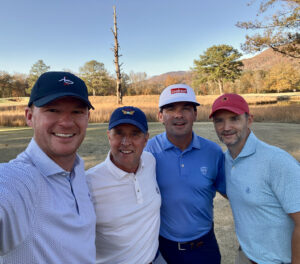
As I said to my contented band of brothers as we left the property at sunset after our full day in the valley, “Sweetens Cove is a damn gift to
golf”.
by Gary Williams | Sep 21, 2023 | Blog
 Being efficient is a redeemable trait and one likely never frowned upon by anyone. The frenetic existence associated with most everyone today makes us inclined to move swiftly and reflect rarely. Getting places, checking boxes and moving on is society’s pace du jour. Life advancement beyond just the biological is likely predicated on being proficient at not taking a lot of time to do anything. Golf has spent its existence trying to make the exercise faster and I’m here for ready golf and the abolition of aim pointers at the recreational level. However, there is a place which used to not exist 30 years ago in the golf universe that has made getting there the most rewarding thing to happen to my relationship with the game since Dad left this earth.
The next chapter for 5 Clubs includes special places and the people responsible for those places being special. My choice all along, when we were ready to embark on that next chapter was a place with very little history. Once CapRock Ranch is seen it will not take much time for it to be considered among the absolute finest and most memorable golf courses this country has to offer the world. Nestled on the northern edge of the Sand Hills region of Nebraska, CapRock is not around any corner. Sand Hills Golf Club in Mullen, Nebraska is 65 miles south of CapRock Ranch and Sand Hills, the club, changed golf forever. Dick Youngscap, a rancher from Lincoln, had a dream and the realization of that dream shifted the dormant design industry into the cavalier, inventive and forward thinking force it is today. Build it and they will come. Golf took the ‘Field of Dreams” screenplay and made it real life one state over from baseball’s version. I always believed once I got there it would be all I was hoping it would be and it was. I just simply couldn’t have foreseen the fortifying qualities of the journey to get there.
One of the overarching themes of addiction and alcoholism is the constant pursuit of isolation. When the choice of fight or flight presented itself, I was more than ready to flee the scene. My life by the time alcohol had taken a death grip over me was a series of escapes. I was always running away from something. Fear, grief, shame, dread, or just being observed were the root causes but I never achieved freedom because I was imprisoned by my disease. Sobriety helps you run toward things and not away from everything. Engagement with others, with nature and with one’s self are reflexive with a full heart and a clear mind. A trip to golf’s new holy land was a gift to pursue all the things I used to avoid. I’m not suggesting two flight connections is a gift but my transition from cynic to pragmatist is a work in progress and there has been progress.
I purchased Dave Kindred’s new book, “My Home Team” which is the poignant memoir of a man who has spent his life writing about the most significant figures and events in the sports world for the last 50 years. My admiration for Kindred’s work and career are immense and his story of his love of writing, his wife and girls high school basketball is poignant and powerful. His reflections on his life filled me with appreciation and got my mind in the right place for a journey to the chop hills and desolate dunes of northern Nebraska.
A regional jet from Denver to North Platte, Nebraska is filled with people returning to where they are from, but it now includes golfers traveling with a purpose. A trip to Nebraska for golf is generally not made in haste and many making the journey understand the importance of adding the experience to their overall context of golf in America. Michael Chadwick, a young man from Los Angeles, sitting a row behind me introduced himself and told me he had read what I wrote earlier in the summer about Crystal Downs. That admission alone validated to me that my musings were all worth it! Michael had also played Crystal Downs for the first time this year and he was on his way to Sand Hills and CapRock Ranch for his maiden voyage around both courses. His depth of knowledge about many things underscores what is happening currently in the game. The care and commitment people are giving to their relationship with the game is cresting. After sharing our itineraries, I got in my rented black Toyota Camry for the three-hour drive to the edges of the Snake River Canyon.
The Sand Hills region of Nebraska is the largest sand dune formation in the western hemisphere. Moreover, the sandy soil is not conducive to growing crops so the twenty thousand square miles that make up this geologic wonderland have never been plowed. Endless waves of rolling sand dunes rising and falling as far as the eye can see accented by the regions primary tenant, black angus cattle. On a warm Saturday evening I was headed northwest on highway 97 into the most extraordinarily fertile 140-mile stretch of a golfer’s imagination. Enormous natural landforms with large swaths of native grasses torn away by erosion creating countless great hazards that only A.W. Tillinghast could envision. Yet I was seeing them as the light was softening despite driving from central time into mountain time. Only one green at Sand Hills golf club is manmade and that only amplifies the restraint Coore and Crenshaw showed in the course’s construction. I was being overrun by images of tilted greens on pushed up shelves of naturally formed bunkers. Expansive fairways, narrow corridors, majestic vistas from one area of the course across to another were all out in front of me, except they weren’t. It’s the world’s greatest, most vast, and virtually untouched golf canvas on earth. It’s also, more importantly, a place rich with something we all seem to have a lack of, peace and quiet. Losing cell reception should be required of each of us periodically to get back in touch with a diminishing commodity, solitude. As I passed the modest sign for Sand Hills Golf Club, I made my way into downtown Mullen and a quick stop at the Kwik Stop. Convenience stores in Nebraska are hearty like the land. In my former life the presence of every imaginable liquor where you also buy funyuns and fill up your car with gas would have been a more desired destination than Steak 48. The young lady in front of me in line with the worn ballcap, blue jeans and a six pack of Busch longnecks would have made for an effective poster for the beer, but I don’t think she was looking to post on the “Gram”. More likely just hoping to unwind after a full day of work. Mullen may not know how much affection the golf world has for Mullen but passing through was energizing. I was now pointed due north with the red and orange of the out of sight sun to my left and the last 70 miles of Highway 97 in front of me.
70 million years ago sharks inhabited the inner seaways of what is now Nebraska. On a glorious clear September night, I was convinced 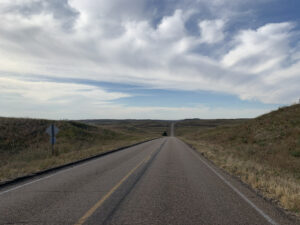 that the ocean was just over the horizon of the last sand dune I could see in the westerly direction. There was literally nothing between me and the entrance to CapRock Ranch except the desolate road until a massive mule deer presented itself in front of the right side of my rental car at 65 miles an hour. The color of the land and the deer marrying each other coupled with the fading light didn’t present me with even a chance to hit the brake. As I hurled the steering wheel to the left the deer struck the right side of the car and was catapulted over the roof and onto the road behind me. The moment didn’t seem real and after stopping the car and determining that the deer did not survive the collision, I was left numb sitting on the now decimated hood of the black Camry with no one in sight. The right side of the car was obliterated yet still drivable, minus the front corner panel of the bumper and the headlight. I was able to continue my procession up highway 97 dazed by the moment and saddened by the result.
The northern edge of the Sand Hills region just south of Valentine and the end of the highway they call “97” is one you’d never associate with the Cornhusker state. The overall absence of corn and flat ground, replaced by the white facing of the Snake River Canyon and hurtling chop hills heaving themselves in all directions would be more closely associated with your image of Montana or Colorado. CapRock Ranch took a circuitous route to its creation, and we are humbled to share its story visually at 5 Clubs Golf very soon. The brilliant blending of holes played toward to the prairie and the infinity look of the Sand Hills to the east and south only compounds the sensory overload you experience as you turn toward the canyon holes looking north and west. Gil Hanse, Jim Wagner, with contributions from Geoff Shackleford and the Caveman team created a routing so shrewd and stimulating it leaves you wrestling with which among the countless fantastic holes is your favorite. The set of par 3 holes… 3,6,9,16, and 18 might be the five best on any course in the country. Yes, the best. The walk off the back of the 15th green on the closely mown area that blends the back of the green seamlessly into the 16th tee is your first look toward home with purpose. I promise you there are few sites in golf more breathtaking than the final three against, and over, the canyon.
There is a small sign behind the 18th green noting that “voices carry” across the canyon. You might hear a faint voice almost a mile away on the 5th green as you hit your tee shot on the 18th hole. Things are uninterrupted in northern Nebraska. From voices traveling across the canyon to the showering of radiant starlight after nightfall you find yourself penetrated by many things normally drowned out by the persistent noise of most of our lives. I spent time at first light and last light on different places to gather as wide a lens as I could of this prepossessing parcel of land. The blowout bunker left of the 12th tee at sunrise, the shadows created across the 3rd green late in the day and the enormity of the view from the 6th green looking down at the Snake River 250 feet below the putting surface and the white rock façade. In its infancy CapRock Ranch has immediately become one of the most captivating visuals in golf. It’s also a superior golf course that will be lauded by design aficionados as soon as they have time to digest the experience.
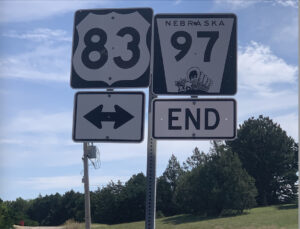 Going to a destination void of so many things we seem to rely on suggests we’d be deprived. On the contrary, northern Nebraska gave me so much of what we can’t find every day. Serenity, solitude and immense gratitude for the vastness of rivers, valleys, and sand dunes converging together. I drove north on Highway 97 ten miles upon my departure from CapRock Ranch to Valentine, population 2800. That is where Highway 97 ends on the northern side of things. I wanted to drive this unfiltered road from end to end back to North Platte. I was stopped south of the Merritt Reservoir because there was road work being conducted. In the 12 minutes I was stopped with one-way traffic for two miles not one car approached me from the rear. I pulled over at the mile marker where I struck the deer three days before and sat on the damaged hood of the Camry and looked out for miles and miles at the enormity of the landscape inhabited by so many living things. I stopped in Mullen, halfway back to North Platte, to see the football field of the Mullen High 7-man football team. Finally, I swung into the Sand Hills Golf Club, two miles off Highway 97 to say hi to the staff at one of the world’s greatest and historically most important clubs. As Highway 97 was coming to an end upon reaching the city limits of North Platte it felt like I was entering a city the size of Omaha and not one with a population of 27,000 people. Traffic, stop lights, congestion, air and light pollution all in abundance. It was like re-entering the atmosphere from another dimension. My 6 am flight the next morning on a regional jet full of people going somewhere included Michael Chadwick making his way home to California. His golf season effectively over with the impending birth of a second child with his wife. He shared his first impressions of Sand Hills and CapRock Ranch, and we discussed the unique landform that connects the 2nd and 14th greens at CapRock and exchanged contact information for a round of golf somewhere down the road. It’s what golfers do.
by Gary Williams | Sep 9, 2023 | Blog
 Over time reputations are usually earned and perceptions are usually distorted. People and places validate what we’ve heard about them with exposure to them. Affirmations are the bedrock of our beliefs. We arrive at the positions we hold through observation and experience which makes our evidence empirical. The contaminate at arriving at a sensible and objective position is of course, bias. Guess what, most of our thoughts and feelings are influenced by bias, to varying degrees. I know I’m biased but it won’t change what is empirically true about the state I grew up in. New Jersey’s roster of golf courses is in the heavyweight class. I just knew where I was lucky enough to learn to play, Ridgewood Country Club, was special but time and experience have only reaffirmed what I came to believe after seeing the country. Jersey is strong.
The perception of New Jersey has always been distorted by first impressions, most consistently and notably with an arrival into the Newark airport. It’s an industrial horror film, mixed with the anger and discontentment of virtually every person you may encounter between your arrival gate and baggage claim. If you can survive to venture in any direction 20 miles and beyond you will find some of the finest golf courses and bucolic towns in America. Returning to Jersey as a I did last week is and always will be nostalgic. I cherish my childhood memories and, although the overwhelming majority of my life has now been spent outside Bergen County, I will always be from there. The first major championship I attended was at Baltusrol in 1980 when Jack was back. Playing the state championships at Hominy Hill was the first real intense sense of team golf I ever experienced. Sneaking on the likes of White Beeches and Alpine Country Club with a side trip to drive by Brooke Shields house in Haworth were epic and dangerous days, by a golfer’s standard. And in 1984 I played Pine Valley for the first time, as a junior in high school. Here’s the thing, all giddiness and awe that I felt that rainy April day of ‘84 is precisely what I felt last week arriving in the municipality that is Pine Valley.
George Crump had a dream, and, in actuality, it was really a pipe dream. But his dream was one he would share not only with his sister, who helped him forge on with the construction of Pine Valley, but also with a roster of architectural golf minds led by Harry Colt as well as the pioneers of golf course design in America. At the time of the construction of Pine Valley the Cobbs Creek project in Philadelphia was also being executed. The men who were contributors to both included George Crump, Hugh Wilson, George Thomas, William Flynn, Walter Travis and A.W. Tillinghast. Coupled with the input and early feedback from the likes of Francis Quimet, Jerry Travers, Chick Evans, William Fownes and John G. Anderson, Pine Valley was an American golf marvel that garnered attention and adulation from every important figure in the infancy of the game in the United States. Famed writer Grantland Rice, a confidant of Bobby Jones, wrote in his “Evening Ledger” column after playing Pine Valley for the first time in 1916, “Pine Valley comes as close to being a flawless test of the ancient Scottish game as the imagination could devise”.
Returning to Pine Valley, as I have periodically through the years, I’m always struck by its unique rugged presentation. The imitation of PV has  been going on for the last 100 years in golf design and with all the technological advancement you’d think the ability to replicate the crude edges and harsh angles of the bunkering at Pine Valley would have maybe even improved upon, but it hasn’t. The clubhouse is sturdy but doesn’t seek attention. It’s almost too practical in its usefulness as a domicile to preview and review your day of golf. History has a head start on everything and the profiles and portraits that adorn the walls of the clubhouse of the men who made Pine Valley fortify the facility’s sturdiness and its historical place in the game. One gaze at a life-size picture of George Crump validates your belief that he was a reflection of the course he created. Brawny, all grown up, and didn’t suffer fools.
The genius of the routing at Pine Valley was not predicated on returning to the clubhouse after nine holes. Whether it was by direct intent, you come back by the clubhouse after completing four holes maybe to allow those simply lacking in resolve to tuck tail and depart before further humiliation. More likely, the visionaries of Pine Valley were determined to build the best 18 holes without enormous regard for halfway houses. Thank you gentlemen for caring most about what matters most, the holes. In an era where tree excavation is a passionate principle of many of the most trusted restorers of great golf courses Pine Valley is an uninterrupted walk. Meaning, few holes are viewed from the hole you are playing. The dense woodlands that made up the original parcel of land used for the golf course remain dense. It’s almost not until you arrive at the next tee do you get to view the next hole. It’s not a question of identifying the weakest hole, but rather what is the toughest, most strategic, most beguiling, and most picturesque. The second tee is the first optical overload your mind must process. The fairway, bracketed by menacing minuscule bunkers, is amplified by the cascading array of bunkers that front the elevated green. It’s the first of many Pine Valley postcards. The roll of the land takes you down to the par 3 third green and then back up to the apex of the ridge that runs across the fourth fairway and down to the fourth green. The fifth is inarguably one of the finest and most punishing long par 3’s in the world. The remaining holes on the front nine are a glorious blend of abrupt angles, hells half acre, not one but two postage stamp greens on the eighth and the choices of two greens on the unrelenting ninth hole. I’m a huge fan of cozy and 10, 11 and 12 are the cozy corridors of PV. Only to transition to the broad and wide scale of 13, the real elevation change of 14 and then the grand tilt of the 15th hole. The closing holes at Pine Valley are not any departure from the previous 15, just a genius flow that takes you back to where you started with a rolodex of images and looks that you’ll hold onto upon departure. My favorite view on the property is standing on the back left portion of the 10th tee and looking back down the 18th fairway to the home green. It is right there that I marvel at the gravitas of the visionaries to see what they saw and have the temerity to pull it off. Standing on high pondering the modesty of the equipment at their disposal and realizing that their collective determination and creativity could produce a stand-alone golf experience.
 Golf requires acceptance. Without it, the game will repel you out of it or you will meekly extricate yourself from the experience. Playing Pine Valley may demand the highest degree of acceptance because it is exacting and unforgiving. A solid start can be eviscerated by one horrifying lie. Putting from the wrong side of holes too often will likely strip you of conviction with the putter and the enormity of the experience takes a toll on your focus. It is overwhelming to experience to Pine Valley… snapper soup, the flex of the members only logo, the haunting cart rides from the practice tee back to the clubhouse, but most importantly the holes. It’s the most consistent and sturdiest 18 consecutive holes I’ve ever played in the United States. A reputation earned.
by Gary Williams | Aug 27, 2023 | Blog
 Life is made up of decisions, big and small. Each day includes countless choices that impact us and those around us and some of the simplest decisions wind up having a profound impact on the course of lives and generations that follow. We can all look back on decisions we have made, and we do, and assess whether they were the right ones and if we would do anything differently. What if the Green Bay Packers chose not to hire the offensive coordinator of the New York Giants to become their head coach in 1959? Would Vince Lombardi have made some other city Titletown? The history of the NBA would look profoundly different if the Portland Trailblazers drafted Michael Jordan second in the 1984 NBA draft, like Bobby Knight implored them to do. What if Tom Butters, the then athletic director at Duke University, succumbed to the pressure to fire Mike Kryzewski after his third season as head coach in 1983 when the Blue Devils were losing to the likes of Wagner College? If a different direction had been taken or the previous course hadn’t been abandoned the industries of those sporting enterprises would be consequentially different. Which brings us to the Sistine Chapel of American golf courses, Cypress Point.
You don’t play Cypress Point, you experience it. That is what I did this past Friday alongside my three fraternity brothers from Vanderbilt with whom I’ve taken some memorable walks at some of golf’s great haunts. Cypress Point is not a fair fight, like Augusta National, but for different reasons. Augusta has historic shots to reference on virtually every hole which provides anyone experiencing the golf course with a catalog of moments that no other course in the world can match. Coupled with the security and the gate at the beginning of Magnolia Lane, ANGC is golf’s true forbidden city. Cypress Point resides on the most extraordinary stretch of northern California coastline and by the time you arrive at the modest entrance right off 17 Mile Drive you’ve already experienced sensory overload. Not only is there no other golf course with the surrounds that Cypress Point enjoys, its simply unfathomable that a course of its reputation and locale could ever be replicated in the United States today.
Augusta National and Cypress Point also have another significant thread they share that makes their stature and lore in the game unapproachable by other historically great golf courses in America. That common thread is Dr. Alistair Mackenzie. But what if the opportunity to complete the work of Seth Raynor who was hired to design Cypress Point was not given to Mackenzie after Raynor’s death from pneumonia at the age of 51 in 1926? Would Bobby Jones’ first impression of Cypress Point in 1929 after losing in the U.S. Amateur been less enthusiastic? These thoughts were running through my mind as I took in Cypress Point again on an overcast and eerily still day on the Monterrey Peninsula.
It seems unfathomable that the routing of Cypress Point which was started by Raynor and completed by Mackenzie would have left Jones uninspired. Raynor was commissioned to design Monterrey Peninsula’s Dunes course as well as Cypress Point, and upon his death, Robert Hunter completed the work at MPCC. Raynor was C.B. MacDonald’s right-hand man, the father of golf course design in America, and Raynor became prolific after MacDonald’s desire to build courses started to wane. Raynor’s background as an engineer and freelance land surveyor made him an expert in moving earth. He was a superior tactician in shaping natural topographies and the application of those skills on a site like Cypress Point make it easy to presume the finished product would have been as breathtaking as the eventual work of Dr. Mackenzie. But consider what that might have meant for the presentation of Cypress Point today if the template of “template holes” had been carried out by Raynor? That’s what was racing through my mind as I traversed the epic dunes, the del monte forest and the rocky coast of Cypress Point with three dear friends. Also suspend reality a little further and ponder what would have become of Augusta National if Seth Raynor was the one who completed Cypress Point and his work had overwhelmed Bobby Jones as Jones began to envision his own course in North Georgia.
But back to Cypress Point… as I was soaking in the genius of what it IS, I was simultaneously trying to visualize the application of an Eden, a  Redan, a Punchbowl, a Biarritz, an Alps, A Short, and a Road Hole. I know, it’s crazy but is it really? It was supposed to be Raynor’s place, and it only became time for Mackenzie because Raynor died. Some people have a thousand swing thoughts, I try to focus on one simple swing key and the rest of my mind drifts toward looking at landforms and geeking out about the people who formed these clubs and the conversations that were had almost 100 years ago. Cypress Point bathes in its simplicity as a club and overwhelms you with its understated celebration of its history. The photos on the walls of the modest men’s locker room are a rolodex of king makers and golf afficionados. From Samuel Morse to Sandy Tatum, to Bing Crosby, who made the 2nd hole in one on the majestic 16th hole in 1947, to Eddie Lowery, the pint-sized caddy for Francis Quimet in 1913 at Brookline. All these men had rich history at Cypress Point. The famous match pitting Ben Hogan and Byron Nelson against Ken Venturi and Harvey Ward in 1956 that produced the wonderful book by Mark Frost titled, “The Match” was a topic of conversation at dinner the night before our round. My boys I was with have all read the book multiple times, and Bill Bunce, an elite amateur in Northern California presently, still seems mystified that the quality of play that day could have been that good. What Cypress Point lacks in on camera moments it makes up for in almost mythical anecdotes.
The Walker Cup will return to Cypress in 2025 and we devoted time to surveying where they might manufacturer teeing grounds to offset the unrelenting length of today’s young elite amateurs. Our caddies insisted the club is going to play it from the yardage they have and as a match play competition it presents countless scoring opportunities. And not that I needed to get the fellas lathered up for our day at Cypress, but I sent them Golf Digest’s, “All 18 holes at Cypress Point” narrated by Jim Nantz. There are other experiences that have a tapestry of historical elements to lean into while also possessing a modesty of public exposure like National Golf Links, Seminole, and Chicago Golf Club. These types of experiences, with great company, who possess golf bonafides are the days I cherish most.
As for why Cypress Point, designed ultimately by Alistair Mackenzie, is so good is because the thing so often overlooked by most everyone when talking about why we play the game is because it’s so damn fun. From the opening tee shot over the hedge that fronts 17-mile drive to the sandy ridge that you play alongside on the par 5 second to the walk into the forest on the 4th you are presented many early opportunities. Three par 5’s in the first 6 holes and two short fours to close the opening nine, that play in opposite directions along one of the most pronounced landforms on the property makes the front a fun factory. It’s the opposite of formulaic. Holes 11, 12 and 13, into the prevailing wind is the sternest stretch on the course and then you get to the greatest walk across the street in all of golf. Once again, defying convention, Mackenzie created back-to-back par 3’s on 15 and 16 that utilize the rocky coast in the most singular way ever conceived. Coupled with the different directions and pronounced dispersion in yardages, the two holes embody contrast. The 17th is your final consumption of heaven on earth before turning up the hill and the finish. As for the 18th, its quirky and for more than a few it is deflating, but I’ve always been good with the home hole. Cypress Point shouldn’t end with something overly long and the cozy corridor up the hill has always felt good to me after the kaleidoscope of color, sound and scale you experience on 15, 16 and 17. In totality it’s the antithesis of conformity which is why it may be the closest thing to the best way to ever experience the game.
 You likely know by now that it’s about the time not the score for me. The plaque on 17 tee, with the words of long time member Clarke
Bearden titled, “Boney’s pulpit” reads, “Gentlemen, I suggest we pause for a moment, admire the beautiful view and count our blessings. Very few of us are privileged to pass this way”. The plaque almost seems too contrived that someone could express what everyone likely feels at that stage of the round but it’s simply the truth. Hitting it out of the center of the face still matters and executing a competent plan is somewhat important but the reward of having an experience that makes your mind race is exponentially more redeeming. One thing that has always been true about a round at Cypress Point is the affirmation that we all were at the right place at the right time, at least on that day.
by Gary Williams | Aug 16, 2023 | Blog
 Access is inspirational. The impetus for inspiration is not age-specific but we are most impressionable as we form our views and our motivations at tender ages. Seeing sites that are challenging to describe, sharing a conversation with someone who may change the trajectory of your life, and being given a platform to refine a skill that may define your professional life are events and experiences that are not forgotten. They are also likely to instill a level of gratitude that will envelope you to give yourself once you’re in a position to do so. Who gave you a chance, a break, an opportunity? What and who drove you to strive and commit to a craft, a pursuit or a passion? We all need advocacy in life. For many their parents may be that support system that foundationally gives them what they need to make their way into adulthood with presence and belief. For far more, someone or something intersected whenever or wherever and set them in motion. For far too long, golf, the culture of golf, reflexively kept too many from access and opportunity. Then Steph Curry came along.
I saw him make a jump shot at a very young age, and not long after that I saw him hit a golf shot. The former was a skill that he was refining in a way that would revolutionize the sport of basketball. The latter was and is a work in progress, but his competency is uncommon for an active world class basketball player who only plays a finite number of rounds a year. But it’s not how Stephen plays golf; it’s how he thinks about golf. He sees things broadly and boldly. Yes, he is driven to refine is personal skill but far more importantly, he’s committed to make golf look more like everything and everyone. Many groundbreaking ideas are not hatched in think tanks or in antiseptic boardrooms with marketing wizards white boarding concepts. The Underrated Golf Tour was conceived in its most rudimentary form on a napkin in a restaurant in Toronto. Steph knew golf was going to be a big part of what was next after he puts a bow on one of the most scintillating and extraordinary careers in the history of basketball. But it just couldn’t be how much or how well he played that was going to stimulate or satisfy Steph. He knew what being overlooked felt like at the age that things impact you and those are the things that are never forgotten. More profoundly, Steph knew that far too many, and for far too long, had been left out of the game of golf.
The Underrated Golf Tour is not just a series of golf tournaments for many young black and brown kids. It’s a platform and a movement to  change the way the game sees itself. The meritocracy of the game is endearing in that the ball doesn’t know who is hitting it and doesn’t care who is putting the number in each box on the scorecard. The blight on the game was that the opportunity was being denied to countless people to hit the shots and post a number simply because of how they looked. Golf’s history of exclusion is not isolated in our society but that doesn’t make it acceptable. The culture of golf loves to celebrate the redeemable chapters of its history and progress but collectively would prefer to skirt around the sad and discriminatory chapters. Golf should never run from its history, it needs to acknowledge, learn and advance way past the narrow-mindedness which persisted for way too long. Steph’s vision for Underrated is aspirational and empowering with goals beyond playing opportunities for aspiring college golfers. It’s to change the trajectory of young lives through golf.
With a cadre of corporate partners aligning and investing in the Underrated vision the members of the tour travel throughout the summer to world-class golf facilities at no cost to them or their families. Relationships formed away from the golf course have included interactive panel discussions featuring the likes of Gil Hanse, Seth Waugh and Butch Harmon. In addition, executives from Underrated’s corporate partners provide counsel on career advancement beyond college and player lounges customized at the host hotels with gaming stations give all a home away from the course. As one parent told me, “My son is comfortable on the golf course, but he has never been anywhere else, until now, and its changed him in every way”. And the boys and girls compete at top venues like Chambers Bay, the Park in West Palm, Firestone and Lake Merced while simultaneously fostering relationships for a lifetime.
 International events with playing opportunities for kids outside the United States is coming as well as a supportive and structured internship and job placement programs through an academy is also on the horizon for Underrated. Golf is the vehicle, but Steph understands the narrowness of the road ahead as an aspiring athletes. Making a living playing a sport is rare but using the sport as a means to a professional end is central to the Underrated mission. The tee markers used for the Underrated events say, “Equity, Access, and Opportunity” and they are not simply symbols they are the motivation and the driving force of using golf as an agent for good and for change. Steph Curry revolutionized the game of basketball for the way he played it, and he is driven to alter the game of golf by the way he sees it.
by Gary Williams | Aug 9, 2023 | Blog
Resisting change is akin to breathing while never truly consciously breathing. Whether subtle, profound, sneaky, overt, stealth, or significant, you and everything and everyone around you is in that constant state. In the last three years the NBA has added “play in” games to their playoff format. Major league baseball has added a pitch clock, substitution guidelines, a scheduling overhaul, starting extra innings with men on base, and outlawing of the shift. The National Football League is going to play the Super Bowl in Las Vegas this season after treating Vegas like it was a wagering infested cesspool and den of inequity from the mind of Lucifer for decades. And that Super Bowl will not be a one off, the Shield will race back to Vegas as often as they can. While men’s professional golf has seen seismic change over the past year, the year ahead should be even more disruptive if the members of the PGA Tour truly want to exercise what they have before them.
Arnold Palmer and Jack Nicklaus steered the players into the players division and the birth of the PGA Tour away from the PGA of America more than 50 years ago. Tiger Woods, Rory McIlroy, and the now empowered policy board made up of a majority of players who now have the tee and it’s their time to determine if they have the vision to put in place what the strongest and best tour in the world is going to look like for the next decade and beyond. Getting more money was the easy part, and when you get the money it’s also easy to think that the bulk of the work is done, when it’s just beginning. Getting Tiger, or having Tiger be willing to be activated as a board member, is the most significant development in the history of an otherwise overlooked and toothless position. The players, while possibly shedding a reputation for abject aloofness as it pertains to governance, truly wanted to shift the power of decision-making and policy-building in their favor. Now is when they display what a member run tour truly looks like.
It’s not the tiny fiefdom that was lofted in the air as a trial balloon at the infamous Delaware meeting. That was merely a lazy and selfish attempt to reduce signature events, or for practical matters, the best events into a 40 man speak easy where you play with a gluttonous amount of chips that aren’t even yours. The duplicity of boasting ‘biggest and deepest tour in the world” while trying to shrink the most elite events into a Grove XXIII dogfight with courtesy cars was appalling. Stars drive all sports and should be positioned to control the lion’s share of the revenue as they do in the major sports where fiscal guardrails exist with salary caps and luxury taxes. However, every sport must and does leave the door ajar for the underdog because that dynamic is a crucial thread in the fabric of elite competition. I know Lee Hodges didn’t sell a ticket for the 3M Open but him waxing a field by a touchdown and the extra point is not shocking. It’s the amplification of what we should all know about guys who make a living staking it, they are witches. The tour shouldn’t be stamping that out, they should be proceeding with pragmatism.
100 should be the number for all signature events and cuts should be common and not uncommon. Elite professional golf is for men and women who find comfort with the discomfort of living in the margins. The margins of error with the integrity of each strike on the clubhouse and the margins of what microscopic data separates airborne hours with NetJets from ironing your own joggers in your King room at the SpringHill Suites. Elevation and relegation in sports is compelling especially when it’s up to you alone to determine your destination. It’s also incumbent upon those who climb to the rarest of air in the game that poor play should have consequences. Jason Day and Rickie Fowler should be battling for the comeback player of the year award, if it still existed, because they looked into the abyss and missed cuts and beat it away to rise again. Small aside, bring the award back, the members know plenty of guys are coming back from something.
Next, as Rory McIlroy said in response to my question last October about what the fall should look like, he responded, “Football”. Not the most expansive answer from Rory but the most succinct and on point. With the reduction of field sizes and the necessity for tons of players to get starts in autumn as opposed to the tour going away and letting us pine for it for a couple months, it’s time for the tour to concede to football. Why in the world are the fall events Thursday to Sunday affairs? Maximize America’s obsession with football by getting the hell out of the way of it while also playing off it. Players love the schools they played for and the NFL franchises they root for so play between football weekends instead of existing as ambient noise in the middle of them. Own the weekdays with Tuesday to Friday dates. You fill the days between Monday Night Football and college Gameday and you lead into countless playoff baseball games played at night in the fall. The TV audience is certainly modest but at least it’s yours as opposed to battling every single power 5, soon to be power 2, college game on Saturdays and the monolith that is the NFL on Sundays.
Co-op more events on the DP World Tour while presenting more playing opportunities for DP members like was achieved during the fortnight of the Barbasol and Barricuda. The leaderboards looked like a breakout session of the UN general assembly. The talent is coming from everywhere so the Scottish Open should not be the only event co-sanctioned overseas with the expectation of top 20 players being in the fields. The Dunhill Links and Irish Opens are majestic stages to prop up the Tour silhouette not to mention the inevitable cultivating of a Middle East footprint.
Which leads to the LIV cleansing and players returning to PGA Tour fields.
Whatever happens with the framework of the framework agreement the players who left don’t need some prolonged and punitive process of re-entry. Fans want to see the best players in the most fields together. The Tour spent real money, the members money, with an agency to soil the reputation of the LIV defectors only to normalize and cleanse the whole thing with a hasty agreement to try to agree to partner. For those players who are angry they didn’t get a bag because they stayed loyal, be angry with yourselves, or the commissioner, or your agents but building in firewalls to prevent top players from immediately returning is just hurting the product you now have the most ownership of in the tour’s history. If you want to be pissed at guys who carped on the way out, I get it, but it’s about the product, not your feelings.
As for the vacated board seat this is a very important decision that now rests in the hands of the players and that individual must understand the global sports landscape. This is not about someone who may have invested his company’s money in the PGA Tour, this individual should be in the sports industry. Colin Neville, from Rhein Capital, is now a very key figure for the PGA Tour and its membership. He has been in the middle of countless mergers, acquisitions and significant capital investments in sports franchises and sports enterprises around the world. The new board member, chosen by the player board MUST know the global sports chessboard and in particular the Middle East’s place in it now and going forward. Neville and a true sports industry leader can build the revenue driving tenacles of the tour while also being the active participants working with the PIF to maximize investment. I don’t know how profitable owning and operating golf facilities under the TPC brand may be, certainly better than pre-covid, but is that the best place for the tour to be investing. The Tour’s board as they continue to infuse countless communities with charitable dollars is also now in the “for profit” wilderness and Neville and the future board member selected by Tiger and company should be weaponized to make the players more money in sponsorship but making the tour’s brand more powerful through partnership. If they are going to hand pick someone, hand pick someone who knows how to grow a global sports brand because they’ve already built a global sports brand.
The Tour and Tiger and Rory’s new endeavor TMRW Sports have a partnership agreement as TMRW gets ready to launch in 2024. It’s not unreasonable to consider that the most golf shots Tiger hits in 2024 will be in primetime on a simulator streaming globally and carried on network television from the TMRW sports campus in south Florida. Mike McCarly, the former president of Golf Channel, knows how to build primetime sports properties and Jeff Neubarth who is the head of production, who oversaw the growth of Morning Drive at Golf Channel, and then helped construct the widely creative and innovative digital presence of Callaway golf are a dynamic duo and the tour needs to lean on them to maximize the value of the tour’s biggest and most valuable commodity, their players.
Scary times are when you don’t have a plan, exciting times are when you have a vision and the right people in place to execute a plan. However the tour looks in five years will rise or fall on Tiger and Company’s shoulders because they have what they wanted, it’s their time to use it.