Masters Flag Story
In April 1993, Sharon and I were fortunate to be invited to our first Masters tournament by Cliff Pierce of Columbia South Carolina. In the category of kind deeds being rewarded, his invitation was a result of his returning a favor because I gave him a ride to the St. Louis airport after an NFBA Past Chairman outing at the Lake of the Ozarks Lodge of the Four Seasons. It was on this first visit to Augusta that I purchased my pin flag from the Masters.
Cliff was a food broker for many years. He was truly a southern gentleman and continued to invite Sharon and me for three more consecutive years to attend the Masters. On one of following trips, he asked that we bring our two sons and they were delighted with the southern hospitality given to us at his country club and private dining club. Cliff Pierce will always be remembered by our family for his generous trips to the Masters. Cliff died around 2010.
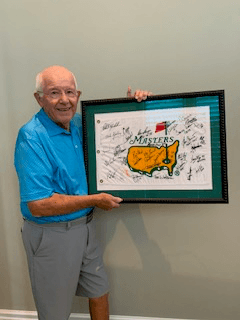
With the background now complete, I get to the meat of this story – how did I get all these names on the Master’s flag.
- Spring 1994 — George Archer was signature #1. The purchased flag was in the trunk of my car the following year (1994) when I attended and played in the Hale Irwin Children’s Hospital tournaments at Old Warson Country Club. I was walking through the parking lot to my car when I spotted George Archer, who won the Masters in 1969. He was literally sitting on the fender of a car in the parking lot when I approached him to get a signature on my flag. He told me to go get it out of the trunk and he’d wait for me.
- 1995 — Bob Goalby was signature #2. It was after the Hale Irwin Children’s Hospital Tournament that summer when we all went into the clubhouse for drinks and a dinner. Bob Goalby was milling around the clubhouse and I asked if he’d sign. He was more than happy to accommodate. Bob was the winner in 1968 as a result of Robert De Vicenzo signing an incorrect score card. De Vincenzo was getting ready for a playoff with Goalby when Tommy Aaron noticed De Vincenzo’s score card was a 66 instead of the correct 65. Once a player signs his card, the score must stand. Goalby was declared the winner.
- August 1996 — Gary Player was signature #3 on the flag. The first of the Boone Valley Classic Senior Tournaments was held this year. I was a member of Boone Valley and a volunteer that worked this tournament as an attendant in the locker room. The Seniors always seem so accommodating at their tournaments. Gary Player has done more to promote golf than most players. He also has been a good example to the younger players for respecting the game and respecting the fans. During the practice round days, I was successful in getting three-time Masters winner Gary Player (1961, 1974, 1978).
- In 1961, Gary beat Arnold Palmer by 4 strokes to win his first green jacket. By that time Arnold Palmer had become an icon and Gary says playing with him gave him all the more determination to win. The winner’s share in 1961 was $20,000.
- In 1974, Gary beat Dave Stockton and Tom Weiskopf who tied for second at 2 strokes behind. The winner’s share in 1974 was $30,000.
- In 1978, Gary overcame a 7-shot deficit to win his third green jacket. Gary would stay in Dan Richardson’s schoolhouse every year that he came to the Boone Valley Classic. While at a tournament in Naples several years later, Gary came up to me at a dinner because I was wearing a Boone Valley logo shirt. He told me that the little schoolhouse he stayed in (Dan Richardson’s home) adjoining Boone Valley was his “all-time favorite place to stay while on tour”. I have been in that little schoolhouse/cabin and the pictures of Gary Player on the walls are numerous.
- August 1996 — Gay Brewer was signature #4 as a result of his 1967 Masters win. I was successful in getting Gay Brewer’s signature at the same Boone Valley Classic. He was returning to the locker room after some practice when he signed the flag. Gay was born in Middletown, Ohio in 1932. He won his only major title by one stroke over runner-up Bobby Nichols. The year before, in 1966, he blew a chance to win the Masters in a loss to Jack Nicklaus in an 18-hole playoff. He didn’t let it get away in 1967. His purse in 1967 for winning was $20,000. Gay Brewer died August 31, 2007 at age 75 in Lexington, Kentucky from lung cancer. He was remembered by the players as a most friendly, funny, and kind man.
- August 1996 — Tommy Aaron was signature #5 having won in 1973. The Boone Valley Classic continued to be fertile ground.. Tommy had just come into the locker room from signing in at the hospitality desk. He saw me coming at him with my flag and said with a big smile “I know what you want”. I replied that I was trying to get past champions and he signed with a smile. Tommy was 36 when he won his only major title, one stroke ahead of runner-up J.C. Snead. Before this win at Augusta, Aaron was best known as the player who kept Roberto De Vincenzo’s incorrect scorecard at the Masters five years earlier in 1968. Ironically, Aaron’s final round playing partner in 1973, Johnny Miller, recorded a higher score when keeping Aaron’s card, and Aaron caught the mistake.
- August 1996 — Charles Coody was signature #6 having won in 1971. He was the final signature during the Boone Valley Senior’s tournament. As with the other three he signed it while I was a volunteer attendant in the locker room. Charles Coody won his only major championship, two strokes ahead of runners-up Johnny Miller and Jack Nicklaus. His winners share in 1971 was $25,000.
- Winter 1999 — Jack Nicklaus was signature #7 having won in 1963, 1965, 1966, 1972, 1975, and 1986. One of my most exciting moments came when I caught up with Jack Nicklaus at the 2000. He was coming off of a green that runs adjacent to the Bonita Bay golf course when I stopped him saying “I’ve been looking for you for a long time”. His reply was “Well, you must not be looking really hard because I’m everywhere”. After telling him “I’m glad I found you today”, I asked if he would kindly take the prime spot in the middle of the shaded section of the flag; and he accommodated. When I walked away with that signature, I felt like a million bucks!
- In the 1963 tournament, the cut was at eight-over-par for the 50 finalists. Jack Nicklaus won it at -2. The purse for 1963 was $20,000 and the Prize fund was $112,500.
- In the 1965 win, he was tied for the lead at the halfway point with the other two members of the Big Three, Arnold Palmer and Gary Player, but shot 64 to tie the course record and take a five-shot lead into the final round. He won at -17 and Player and Palmer were second at -8.
- In the 1966 win, he became the first player to win consecutive Masters. He did it that year by playing an 18-hole playoff with Tommy Jacobs and Gay Brewer.
- The 1972 Masters played tough. Jack entered the final –round with a one-shot lead. His 74 was enough for a three-shot win over Bruce Crampton, Bobby Mitchell, and Tom Weiskopf, all at +1.
- By 1975, the Masters stopped scattering the top players tee times. Regarded as the top three players in the game at the time, Jack Nicklaus, Johnny Miller and Tom Weiskopf all teed off in the final two pairings for the final round. Jack prevailed and won his fifth jacket with a -12. Miller and Weiskopf both finished one shot behind.
- In 1986, Jack won his sixth green jacket. No one gave him a chance at victory. Some even referred to him as the “Golden Bear”, a man who at 46 was past his prime and not capable of competing in the majors. The final round turned out to be exciting for Jack. With Tom Kite and Greg Norman one shot behind going into the 18th, Jack prevailed with the one-shot lead and became the oldest winner of the Masters at 46. His winners share in 1986 was $144,000. The purse was $785,000.
- Winter 2000 — Ray Floyd was signature #8 having won in 1976. I had a great run of luck with the senior tour seemingly taking residency at Twin Eagles CC in Naples. It was the Father-Son Tournament where I caught up with Floyd. While on the back nine of the Talon Course, I stopped him coming off of #14. The Seniors all seem very cordial about mixing with the crowd. Ray Floyd signed my flag and gave numerous signatures to other fans. It was his only Masters title. He won it eight strokes ahead of runner-up Ben Crenshaw. In the first three rounds, Floyd was under-par on every par-5, with eleven birdies and an eagle, and his 54-hole total of 201(-15) was the lowest ever. It was the second of Floyd’s four major titles. Beginning with this Masters, a sudden-death playoff format was introduced.
- Winter 2000— Billy Casper was signature #9 as the 1970 winner. It was the Father-Son Tournament at Twin Eagles CC, Naples, FL. Toward the end of my day at this tournament, I secured Billy Casper’s autograph. It was on his way back to the locker room. When he gave me his autograph, I complimented him on his sensational handwriting. He said “Thanks, I think people like to be able to read it”. Billy Casper defeated Gene Littler 69 to 74 in an 18-hole playoff on Monday to win his third major championship. It was the last 18-hole playoff at the Masters; the format was changed to sudden-death in 1976. Sam Snead played in this 1970 Masters at the age of 57 and finished in a tie for 23rd place. Winner’s share was $25,000.
- 2/6/2002 — Craig Stadler was signature #10 with his playoff win in 1982. This was the first of four signatures I got at the ACE Group Classic, Twin Eagles CC, Naples, FL. Stadler gave me autograph on the practice range prior to his teeing up for this Senior event. If you work really hard, you can make out what might be the most illegible signature on the flag. Stadler won his only major championship by defeating Pohl on the first hole of a sudden-death playoff. In the final round, Stadler shot a 33 on the front, had a six-shot lead with seven holes to play. He proceeded to bogey 4 of those 7 holes while Pohl caught up with him. In the sudden-death playoff, Stadler won with a par when Pohl missed his six-foot par put attempt. 1982 was the final year that players were required to use Augusta National club caddies. Winners share was $65,000.
- 2/6/2002 — Fuzzy Zoeller was signature #11 with a playoff win in 1979. This was the second one I got at the Ace Group Classic, Twin Eagles CC, Naples, FL. Fuzzy Zoeller was cutting up and telling a lot of jokes to the amateurs he was playing with all day. I followed him for a couple holes and was able to get his autograph on the 17th fairway. He very willingly signed my flag with a red pen, the only signature I have in red ink. Fuzzy won his only Masters, the first of his two major titles, with a birdie on the second hole of a playoff with Ed Sneed and Tom Watson. Fuzzy Zoeller, age 27, was the first to win the Masters in his initial attempt since Gene Sarazen did it in 1935. Winners share was $50,000.
- 2/6/2002 — Ben Crenshaw was signature #12 as a result of his two Masters wins in 1984 and 1995. Again, it was the Ace Group Classic, Twin Eagles CC, Naples, FL. that came through for me. Ben Crenshaw looked at my flag after he came off of the 18th green with his group and saw the 11 signatures on it. He commented “Where do you keep this thing?” When I replied that I keep it in a frame at home, he commented “You better put it in a vault!”.
- In 1984 he won by two strokes ahead of Tom Watson. Winners share in 1984 was $108,000 with a purse of $612,900 in 1984.
- In 1995 his one stroke win over Davis Love III was one of golf’s great memories. Ben Crenshaw’s reaction on the 18th green, after winning the Masters, was priceless. He was doubled over crying with his face buried in his hands. He dedicated the win to his close friend, teacher, and mentor, Harvey Penick. The 1995 winners share was $396,000 with a purse of to $2.2 million. in 1995. Ben will also remain one of my idols for his class, character and love for the game. He is the de facto historian for the game.
-
- 2/6/2002 — I had my first defeat. At the Ace Group Classic, Twin Eagles CC, Naples, FL. I followed Tom Watson for a few holes and finally got to talk to him after he came off of Number 12 green. I asked him for a signature and he was very emphatic in telling me “I do not sign anything from the Masters” and walked away. I’m not sure of the reasoning for his statement but I’m sure there is something that bothers him about the tournament. As you will see further in this story, I was fortunate to get his signature because of Jay Delsing (former pro golfer) interceding on my behalf by sending a personal note to Tom requesting a signature for my flag.
- 11/12/2003 — Mark O’Meara was signature #13 by winning in 1998. I secured it at the Greg Norman/Franklin Templeton Shootout, Tiburon Golf Club, Naples, FL. Mark signed my flag as he was coming off of the putting green and preparing to go to the first tee. O’Meara won his first major championship with a 20-foot birdie putt on the final hole to win by one stroke over runners-up David Duval and Fred Couples. This was the first Masters that our sons Doug and Jim ever attended. Our company represented Motts apple products and they were entertaining a St Louis customer at the direction of Motts. Because Motts failed to secure a ticket for Jim, they had to buy a scalp-ticket in Augusta. It was at the 1998 Masters tournament that Jack Nicklaus tied for sixth place at the age of 58. Jack’s final round 68 produced a 283 (-5), the lowest 72-hole score by a player over age 50 at the Masters. Three-time champion Gary Player, age 62, was not to be outdone; he became the oldest ever to make a cut at the Masters. Winners share was $576,000 from a purse of $3.2 million.
- 7/27/2004 — Arnold Palmer was signature #14. Arnold Palmer was a four-time Masters
winner — 1958, 1960, 1962, and 1964. The U.S. Senior Open at Bellerive Country Club, St. Louis MO was the venue. It was Tuesday of the tournament week, when I went over to Bellerive hanging out by the driving range with my Masters flag. Arnold came out to practice early and there were only about 25 people standing by the ropes behind the range. When Arnold started to leave for the course, he came by and signed my flag and whatever the others had to sign. He stayed until everyone got his signature. And yes, his autograph is one of the most legible on the flag. He always felt it was important to sign a legible signature.
- His first Masters victory (1958) was not without some controversy. On the 12th hole of the final round, Palmer thought his tee ball was embedded behind the green but the on-site rules official would not give him relief. Playing that ball as it lay, Palmer made a double-bogey. Upset over the questionable ruling and the double-bogey, Palmer then played a second ball from behind the green and, after taking relief, made a par. Several holes later word came from the tournament officials that Palmer was entitled to relief and his par score on 12 would stand. The winner share was $11,250 with a total purse being $60,050.
- The 1960 Masters also had controversial excitement because Dow Finsterwald received a two-stroke penalty after the second round for violating a local rule, (practice putting on the green following the conclusion of a hole), and lost the title by two strokes. Palmer was the sole leader after all four rounds and was the second wire-to-wire winner at the Masters following Craig Wood in 1941. Since 1960, Jack Nicklaus (1972), Ray Floyd (1976), and Jordan Spieth (2015) have been added to the wire-to-wire list of winners.
- In the 1962 Masters, Arnold Palmer won in the tournament’s first three-way Monday playoff with Gary Player and Dow Finsterwald. It was the fifth of Arnold Palmer’s seven major titles. This was the tournament that increased the 36-hole cut to the low 44 plus ties and anyone within 10 shots of the lead. (Previously it was the low 40 plus ties and anyone within 10 shots of the lead)
- In 1964, Arnold Palmer at age 34, opened with three rounds in the 60’s and led by five strokes after 54 holes at 206 (-10). He carded a final round of 70 on Sunday to win by six strokes to become the first four-time winner of the Masters. It was his seventh and final major victory. The winner’s share was $20,000 and the purse for the tournament was $129,800. Contrast Arnold’s largest winning of a major to today’s almost $2 million. What will the next 50 years bring?
- 7/19/2006 — I received a letter from Janie H. Henderson, Executive Director of the Byron Nelson Championship addressed to Jay Delsing after he sent my flag to his offices in Dallas requesting Byron’s signature. Janie’s remarks included “We received the personal item you sent for Byron Nelson to autograph. However, I did not inquire what the personal item was before you sent it. Unfortunately, Mr. Nelson declines requests to autograph pin flags and Masters-related items. Your Master’s pin flag is enclosed.” She went on to say “We are happy to send you an autographed photo of Byron taken when he was active on the Tour.” I keep the photo with these memoirs.
- 8/11/2006 — Fred Couples was signature #15 for his 1992 victory. The International was being played at Castle Rock, Colorado and Jay Delsing convinced me to let him have the flag for a week while he played the tournament. In the locker room at Castle Rock, during that tournament, Jay secured not only Fred Couples’ signature but those of Bernhard Langer, Larry Mize, and Jose Maria Olazabal. Fred Couples won his only major championship in that Masters. He won by two strokes ahead of 49-year-old runner-up Raymond Floyd, the 1976 champion. Couples was the first American winner in five years at Augusta that year, the longest run at the Masters without a winner from the U.S. The previous four were won by players from Europe, all from the United Kingdom. The winner’s share for Fred Couples was $270,000 from a purse of $1.5 million. .
- 8/11/2006 — Bernard Langer was signature #16 by way of his victories in 1985 and 1993. Langer has always been a favorite of mine because he won at the first Masters tournament Sharon and I attended. I remember standing on the edge of the 18th green when he won in 1993 and the crowd exploded. As he has continued to do so well on the Champions Tour; I still follow him closely. Bernard Langer won the first of his two major championships, both Masters two strokes ahead of runners-up Seve Ballesteros, Raymond Floyd and Curtis Strange. Langer was the first winner of a major from Germany (then West Germany). The winner’s share in 1985 was $126,000 on a purse of $700,793. Bernard Langer went on to win again in 1993, four strokes ahead of runner-up Chip Beck. By 1993, the winners share went to $306,000 on a total purse of $1.7 million; almost 250% more than he won eight years prior. on the flag.
- 8/11/2006 – Larry Mize was signature #17 because of his improbable win in 1987 — “the shot”. Larry Mize signed my flag for Jay Delsing at The International at Castle Rock CO. He also inscribed “Eph 2: 8&9” under his signature. Those verses in the bible say “8 – FOR IT IS BY GRACE YOU HAVE BEEN SAVED, THROUGH FAITH—AND THIS IS NOT FROM YOURSELVES, IT IS THE GIFT OF GOD and 9 – NOT BY WORKS, SO THAT NO ONE CAN BOAST.” It appears that Larry Mize is deeply religious and wants to give God credit for his success and attainments. Larry won his only major championship in a sudden-death playoff over Seve Ballesteros and Greg Norman. Norman had barely missed a 20-foot birdie opportunity on the 72nd hole which would have won him the tournament in regulation. Ballesteros was eliminated on the first playoff hole and on the next hole, the par-4 11th, both Mize and Norman’s first shots were in the fairway. With the pond on the left of the green, Mize’s avoidant approach shot was about pin-high but well right, about 140 feet from the hole. Norman then played conservatively to the right fringe, with a 50-ft putt, sensing a par could win the green jacket. But Mize chipped in for an improbable birdie 3 and a stunned Norman failed to hole his to tie, which ended the tournament. Mize’s shot was considered one of the most miraculous shots (and endings) in major championship history, and was just one of the many “bad breaks” in Norman’s career.
- 8/11/2006 – Jose Maria Olazabal was signature #18 for victories in 1994 and 1999. This was the final signature received by Jay Delsing at The International in Colorado. As Sharon and I attended our second Masters tournament due to the kindness of Cliff Pierce, I remember Tiger Woods teeing-off with Jose Maria Olazabal on Thursday because Tiger was the U.S. Amateur Champion the year before. I think it is still customary for the U.S. Amateur Champ to play with the previous year’s Masters winner the year following the amateur championship. Jose Maria Olazabal won the first of his two Masters titles, two strokes ahead of runner-up Tom Lehman, and became the sixth winner from Europe in the past seven Masters. Olazabal was the second champion from Spain, following Seve Ballesteros, the winner in 1980 and 1983. Jose Maria Olazabal won his second Masters championship, two strokes ahead of runner-up Davis Love III and three strokes ahead of Greg Norman, who experienced another disappointing back nine at Augusta.
Jay Delsing called me again to ask if he could keep the flag for a few more weeks as he was going to the Bridgestone Invitational in a few weeks at Firestone CC in Akron Ohio. By now I think Jay was starting to enjoy the challenge of getting these Masters winners also. Jay suggested that perhaps he could get Tiger’s signature at Firestone CC in Akron, one that I knew would be difficult to pursue. I mentioned to Jay that I would be willing to make a donation to his Foundation if that was necessary. Jay solicited the help of Corey Pavin, one of his college teammates at UCLA. Corey, who played that tournament, took it to the locker room. Corey returned the flag from the Bridgestone Invitational with four more Masters signatures. (Tiger Woods, Phil Mickelson, Mike Weir, and V.J. Singh). Prior to Jay’s suggestion that he take the flag on this trip, I had never let the flag out of my possession. While I was concerned, I knew Jay would keep it safe. I never could have dreamed that August of 2006 would produce eight signatures on the flag, and some of the biggest names in golf.
- 8/27/2006 — Tiger Woods was signature #19 with a spectacular winning record — 1997, 2001, 2002, 2005 and 2019. With the help of Corey Pavin, I was able to secure what I thought would be the toughest signature in golf.
- 1997 Tiger’s first major championship, twelve strokes ahead of runner-up Tom Kite. Through 2018, the margin of victory and four-day score of 270 (-18) are tournament records. Woods also became both the youngest (21) and the first non-white player to win at Augusta. Woods’ victory set television ratings records for golf; the final broadcast on Sunday was seen by an estimated 44 million viewers in the United States. It is safe to say, this Masters tournament changed the dynamics of golf. In 1997 Tigers winning share was $486,000 and the purse was $2.7 million.
- The 2001 Masters Tournament was a special event for me. Sharon and our sons, Doug and Jim were invited to the tournament by Cliff Pierce. We were all at the number one tee when Tiger started this tournament. It was also special for Tiger as it gave Tiger Woods his second Masters win and sixth major championship, two strokes ahead of runner-up David Duval. This championship marked the completion of the “Tiger Slam,” with Woods holding all four major titles, having won the U. S. Open, Open Championship, and the PGA Championship in 2000. This was also the first major with a seven-figure winner’s share. Tiger won $1,008,000 at this tournament. The purse was $5,600,000. The first six-figure winners share was 18 years earlier at the 1983 PGA Championship.
- In 2002, Tiger Woods won his third Masters, and second consecutive, with a score of 276 (-12), three strokes ahead of runner-up Retief Goosen. The course was lengthened by 285 yards over the previous year. It was only the third successful defense of a Masters title, previously accomplished in 1966 by Jack Nicklaus and 1990 by Nick Faldo. The purse and winner’s share stayed the same as the previous year. Having said that, Tiger collected $2,016,000 just from the Masters over the previous 12 months.
- The 2005 Masters produced the fourth green jacket for Tiger Woods on the first hole of a playoff with Chris DiMarco. The purse was $7.0 million with a winner’s share of $1.26 million. It was the ninth of Woods fourteen major championships. This Masters was the last competition for three former champions: Tommy Aaron (1973), Billy Casper (1970), and six-time winner Jack Nicklaus.
- On Sunday April 14, 2019, Tiger Woods made history at the Masters by winning his fifth green jacket. Tiger’s one-shot victory at Augusta National capped off an amazing and lengthy comeback from personal setbacks and physical ailments. Just two years prior, Tiger laid on his back in a hospital wondering if he would ever play golf again. Some think this is the greatest comeback in sports ever and probably the reason for calling it a historical event. Tiger was teamed-up with Fransesco Molinary on Sunday in the last group. Molinary was pretty unflappable with the lead going into the 12th hole, (Amen Corner). Molinari double-bogeyed the par-3 12th after hitting into the water. And then when Molinary did it again on the par-5 15th and Tiger birdied it, Tiger took the lead. Tiger birdied the par-3 16th to take a two-shot lead. He finally won it with a bogey on number 18. Koepka had a chance to tie if he could birdy the last hole. He makes par and Tiger recorded the win for the fifth time at Augusta. This was Tiger’s 15th major win, just three shy of Jack Nicklaus’ record. This being the 83rd time the Masters was played, it was the first time the winner was awarded over $2 Million. Tiger’s take was $2,070,000 on a purse of $11,500,000. Contrast that to his $486,000 winning share in 1997 on a purse of $2,700,000.
- 8/27/2006 — Phil Mickelson was signature #20 and the second signature obtained at the Bridgestone Invitational by Jay. Mickelson, the 2004, 2006 and 2010 winner was all Phil.
- In April 2004, all those major questions about Phil Mickelson being able to win a major ended. He had 46 major starts when he rolled in a birdie putt to win the 68th Masters Tournament by one shot. He won by one stroke over Ernie Els. Phil Mickelson said at his news conference that day “I’d like to say to members of Augusta National: Please get used to me, because I’m going to be back every year”. Phil’s winnings were $1,179,000 and the purse was $6 million. This was the 50th consecutive and final Masters appearance for four-time champion Arnold Palmer.
- In 2006, the course was lengthened by 155 yards to 7,445 yards, up from 7,290 in 2005. Phil Mickelson won the second of his three Masters and second consecutive major with a 281 (-7), two strokes ahead of runner-up Tim Clark. The purse was $7 million and the winner’s share was $1.26 million. This was the final Masters appearance for three-time champion Nick Faldo.
- In 2010, Phil Mickelson won his third Masters and fourth major title, three shots ahead of runner-up Lee Westwood. Phil’s winning share was $1,350,000 on a purse of $7.5 million.
- 8/27/2006 — Mike Weir was signature #21 by winning in 2003 and was the third golfer Corey Pavin found at the Bridgestone Invitational—Firestone CC, Akron OH. Mike Weir won his only major title in a one-hole playoff over Len Mattiace. He was the first and only Canadian to win a major, and also the first left-handed player to win the Masters. Mike won with a 281 (-7), playoff. His winnings were $1,080,000 and the purse was $6 million.
- 8/27/2006 — V. J. Singh was signature #22 as a result of his 2000 victory. This was the final signature obtained by Corey Pavin that week. Corey gave the flag back to Jay Delsing after the tournament and Jay returned it to me the following week. When I met Jay to retrieve the flag, I could not believe my eyes when I stared at the eight new signatures. (Couples, Langer, Mize, Olazabal, Tiger, Mickelson, Weir, and Singh) I was ecstatic and starting to realize that I now had more Masters signatures on any one flag that I had ever seen. (Prior to this, I had witnessed one that had 19 signatures on it). V. J. Sing “the Big Fijian” won his only Masters, three strokes ahead of runner-up Ernie Els. It was the second of Singh’s three major titles. V.J. held the #1 World Ranking in golf for 32 weeks in 2004-2005. The winner’s share was $828,000 and the purse was $4.6 million.
- 11/8/2006 — Nick Faldo was signature #23 as a triple winner in years 1989, 1990 and 1996. I chose early Wednesday morning of the Merrill Lynch/Greg Norman Shootout, Tiburon, Naples, FL to hang out by the driving range. At about 7:20am Nick was coming off the range and headed to the practice putting area when he stopped to sign my flag at the back of the cart he was using.
- In 1989 Nick Faldo won the first of his three Masters titles. It was the second of his six major championships. After a third round 77 (+5), he shot a final round 65 (-7) and won with a birdie on the second hole of a sudden-death playoff with Scott Hoch. This Masters is remembered for Hoch missing a two-foot putt on the first playoff hole that would have won him the green jacket. Greg Norman continued his misfortunes at the Masters with a bogey on the 72nd hole to miss a playoff by a stroke, similar to 1986. Third round leader Ben Crenshaw also bogeyed the final hole to tie Norman for third. Faldo became the first man from England to win the Masters and was the second consecutive winner from the United Kingdom. Defending champion Sandy Lyle of Scotland missed the cut by two strokes. Faldo’s winner’s share was $225,000 on a purse of $1.25 million.
- In 1990, Nick Faldo won his second consecutive Masters and the third of his six major titles on the second sudden-death playoff hole over Raymond Floyd, the 1976 champion. Floyd took it hard because this loss to Nick Faldo foiled his attempt to win a major in four different decades. Nick Faldo was just the second to win consecutive titles at Augusta, following Jack Nicklaus (1965 and 1966). Since then, Tiger Woods has won back-to-back. (2001 and 2002). Faldo’s winnings were $225,000 and the purse was $1.25 million.
- In 1996, Nick Faldo’s win will always be remembered. It was Nick’s third Masters and his sixth and final major title, five strokes ahead of runner-up Greg Norman. Faldo overcame a six-stroke deficit going into the final day as Norman, leader after each of the first three rounds, faltered down the stretch once again at Augusta. In the final round, Norman maintained a four-shot lead through 7 holes, and then proceeded to lose five shots to par over the next five holes. Faldo picked up one birdie in that stretch to assume a two-shot lead after Norman’s tee shot on 12 found the water for a double-bogey. Any thoughts of Norman winning were dashed when his tee shot on the par three 16th also found water. Nick Faldo’s 67 was the best round of the day while Norman’s 78 was one of the worst rounds of the day, together yielding the greatest comeback/collapse in Masters history. The winner’s share was $450,000 and the purse was $2.5 million.
- 12/2/2006 — Doug Ford was signature #24 as the winner way back in 1957. As a result of Jay Delsing personally calling Doug Ford, we were instructed to send the flag to his home and he would be happy to sign it. Doug was living in retirement in Gulf Stream Florida. I FedEx’d it to Doug and he returned it within just a few days. Doug enjoys being the signature of the earliest Masters year on my flag—1957. The 1957 Masters was the 21st Masters tournament and the first Masters played with a 36-hole cut. A field of 101 players started in the tournament, and 40 of them made the cut at 150 (+6). Doug Ford won his only Masters, three strokes ahead of runner-up Sam Snead, a three-time champion. Snead was a third-round leader, but could only shoot even-par in a round that included six birdies and six bogeys. Ford was three strokes back after 54 holes but was bogey-free on Sunday. On the final hole, Ford holed out from the bunker for birdie for his 66 (-6). This was Ford’s second and final major title; he also won the 1955 PGA Championship. The winners share of the Masters was $8,750. Doug Ford died at his home in 2018 at the age of 95.
- 12/5/2007 — Zach Johnson was signature #25 with his 2007 win. I caught him at the Merrill Lynch/Greg Norman Shootout, Tiburon, Naples FL. Being unable to catch Zach on the driving range, I followed him during one of the pro-am days and caught up with him on hole #4. He was very gracious to come off the tee box and give me his signature by the cart. He had just won the Masters the past April and said “he was pleased to be among the other greats that were on the flag”. The 2007 Masters was the first major championship won by Zach. He finished two strokes ahead of runners-up Retief Goosen, Rory Sabbatini, and Tiger Woods. Cool temperatures and gusty winds on the weekend resulted in high scores for the field. Johnson’s 289 (+1) tied Sam Snead (1954) and Jack Burke Jr. (1956) for the highest winning score ever at the Masters. His win at the Masters took him from #56 to #15 in the world rankings; he was the first outside the top 50 in the world rankings to win the Masters. Zach played on the Nationwide tour prior to the PGA tour and in 2003 topped the money list with record earnings of $494,882 earning an automatic promotion to the PGA tour. The winners share for the 2007 Masters was $1,305,000 and the purse was $7,418,464.
- 9/2/2008 — Trevor Immelman was signature #26 for his 2008 achievement. He was the only signature I was able to get at the BMW Classic Bellerive Country Club, St. Louis, MO which was held in my home town. I tracked him down at the back of the driving range as he finished warming-up.
- The 2008 Masters was the only major tournament won by Immelman. In 2007, Trevor withdrew from the South African Airways Open due to severe discomfort around his ribcage area that caused a problem breathing. He was diagnosed with a calcified fibrosis tumor that turned out to be benign. Nevertheless, treatment and recovery caused him to miss the first eight weeks of the 2008 PGA Tour season. However, Immelman came back that year to win the 2008 Masters tournament. Despite scoring a double bogey on the 70th hole, the par 3-16th, Immelman finished with a score of 8 under par, beating favorite Tiger Woods by three strokes. As the 2013 PGA Tour neared its conclusion, Immelman’s winless streak extended to five years; he was forced to play in the Web.com Tour Finals after he failed to make the FedEx Cup playoffs and his five-year exemption for winning the Masters expired. Since 2017 Turner Sports has utilized Immelman as an analyst for coverage of the PGA Championship.
- 2/17/2009 — Seve Ballesteros was signature # 27 for his performance in 1980 and 1983. Again, my friend Jay Delsing came to the rescue. Seve was at his home in Santander, Spain recovering from brain surgery. He was diagnosed with brain cancer in 2008. Seve was most accommodating but there was one catch – Jay had to send the flag to him. Although reluctant to sending my treasure in the mail, I did it and held my breath. The entire process took about 10 days. I must admit I thought about it being lost forever several times. For a man as sick as he was, his willingness to honor my request will always be appreciated. Severiano “Seve” Ballesteros was a Spanish professional golfer, a World No.1 who was one of the sport’s leading figures from the mid-1970’s to the mid-1990’s. A member of a gifted golfing family, he won more than 90 international tournaments in his career, including five major championships between 1979 and 1988. The Open Championship three times, and the Masters tournament twice. He gained attention in the golfing world in 1976, when at the age of 19 he finished second at The Open. Ballesteros won a record 50 European Tour titles. He won at least one European Tour title for 17 consecutive years between 1976 and 1992. His final victory was at the 1995 Peugeot Spanish Open. He is generally regarded as the greatest Continental European golfer of all time.
- The 1980 Masters was won by Seve Ballesteros at age 23. He finished four strokes ahead of runners-up Jack Newton and Gibby Gilbert. Ballesteros had a seven-stroke lead after 54 holes and extended it to ten strokes after the front nine of the final round at 16 under par, eyeing the Masters record of -17 set by Nicklaus in 1965 and equaled by Ray Floyd in 1976. A new record was to be rewarded with a $50,000 bonus from Golf Magazine. After finding water on 12 and 13 at Amen Corner, the lead had been reduced to three. He shot a 72 for the final round and held on to victory. The winning share in 1980 was $55,000 on a purse of $359,949.
- 1983 was Ballesteros’ second Masters win and third major title, four strokes ahead of runners-up Ben Crenshaw and Tom Kite. Play on Friday was postponed due to heavy rain, and the final round was completed on Monday for the first time since 1973. Defending champion Craig Stadler was tied for the 54-hole lead with 1976 champion Raymond Floyd, with Ballesteros one stroke back, and two-time champion Tom Watson an additional stroke behind. Ballesteros got off to a fast start in the final round on Monday with a birdie-eagle start. With another birdie at the difficult par-3 fourth, he added four pars and another birdie at the ninth for a five-under 31 on the front nine. Ballesteros cruised to a 69 (-3) and a comfortable win as neither Stadler, Floyd, nor Watson broke par. (Side note: 1983 was the first year that players were allowed to use their own caddies, rather than those of Augusta National. Twelve players continued to use caddies from the club, including Nicklaus. The first female caddie at the Masters appeared this year as George Archer, the 1969 champion, employed his 19-year-old daughter Elizabeth.) The winning share in 1983 was $90,000 and the purse was $500,000Seve lived for two years after signing the flag and died of brain cancer in Spain on May 7, 2011 at the age of 54.
- 3/16/2009 — Tom Watson was signature #28. He won the Masters in 1977 and 1981. Over the years of collecting these signatures, Tom Watson has been called the hardest signature to get. In fact, as mentioned previously; while at the 2002 Ace Golf Classic at Twin Eagles in Naples FL., I stopped Tom on the pro-am day after he and his team had completed number 12 only to be told “I don’t sign anything with Masters logo on it”. While I was a bit stunned by that remark; I did not push it or ask any more questions out of respect for the great player that he is. He must have his own reasons. When I was in the Food Brokerage business, our office in Kansas City represented Gatorade and Tom always signed some Gatorade golf bags for us as a promotion. Disappointed, I mentioned this to Jay Delsing, and he asked if he could intercede. With Tom’s permission, I sent the flag to his home in Mission, Kansas and it is one of the most legible signatures on the flag. Again, I owe Jay Delsing many debts of gratitude.
- The 1977 Masters was the second of Watson’s eight major championships. At age 27, it was the first of his two green jackets, two strokes ahead of runner-up Jack Nicklaus. The two were tied after 68 holes, then Watson birdied the par-4 17th. Needing a birdie to tie, Nicklaus bogeyed the final hole, one of 19 times in his career that he was the runner-up in a major championship. The pair again dueled for a major title in the final round in July in Scotland, at the Open Championship at Turnberry, also won by Watson. Although he had won a major in 1975 and led the PGA Tour in season earnings entering this Masters, Watson had been labeled a “choker” early in his pro career, known for relinquishing leads in the final round of majors and regular events. Notable among these was the U.S. Open in 1974 at Winged Foot; his win here and in Scotland put that to rest. The winner’s share in 1977 was $40,000.
- In 1981, Tom Watson won his second green jacket and fifth major title by two strokes over Nicklaus and Johnny Miller. Five-time champion Nicklaus shot a bogey-free 65 on Friday and led by four strokes after 36 holes, but a 75 on Saturday put him a stroke behind Watson entering the final round. It was the fourth runner-up finish for Nicklaus at the Masters and the third for Miller. Defending champion Seve Ballesteros shot 154 (+ 10) and missed the cut by six strokes. The winner’s share in 1981 was $60,000 and the purse was $362,587. This was the first Masters with bent grass greens, which were formerly Bermuda and ryegrass.
- 2/9/2010 — Ian Woosnam was signature #29 thanks to his 1991 win. The ACE Classic had been moving around in the Naples area and I believe this was the only year that it was played at “The Quarry”. I usually try to spend a few days of each tournament played in the Naples area. On Wednesday, I found Ian Woosnam at the driving range prior to his pro-am round. In 1991 Ian Woosnam won his only major title, one stroke ahead of runner-up Jose Olazabal. Woosnam, Olazabal, and two-time champion Tom Watson, age 41, were all tied at -11 going into the 72nd hole. Olazabal, a group ahead of the final pairing of Woosnam and Watson, went from fairway bunker to greenside bunker and failed to hole a 45-foot par putt. Watson, who had eagled both 13 and 15, missed the fairway right with his tee shot and then hit his second shot into a greenside bunker. He chipped out and three-putted for a double bogey. Woosnam then holed an 8-foot par putt for the green jacket. The winning share in 1991 was $243,000 in a purse of $1.35 million. Phil Mickelson, a 20-year old junior at Arizona State, was the low amateur at 290 (+2) that year, and tied for 46th place. In 2016 Ian Woosnam announced he was playing his last competitive round at the Masters because of its length and his bad back. His last hole in 2016 was memorable. He hooked his drive off an ice machine in the concession stands left of the 18th fairway, took a drop near the eight-tee box and saved par.
- 2/12/2013 — Sandy Lyle was signature #30 with his single Masters Championship in 1988. The ACE Classic, Twin Eagles, Naples, FL. had me at the driving range. Sandy Lyle drove up in his cart and pulled right up near the hitting surface. I stood behind his hitting area for about 30 minutes and when he returned to his cart to tee off with his amateurs, I asked him if I could have a legible signature on my flag. It was common for me to throw in that “legible” part because several of the players don’t take their time signing unless you say that. Well Sandy seemed to take some offense and said “I always have a legible signature”. And sure enough, after getting his signature, it is very legible. I have noticed that the older generation players seem to take more pride in a legible signature. Arnold Palmer was notorious for talking about it. The likes of Sergio, Patrick Reed, Danny Willett, Craig Stadler, and Bubba Watson are tough to read. In 1988 Sandy Lyle won his second major title with a birdie on the 72nd hole to win by one stroke over runner-up Mark Calcavecchia. Lyle led after 36 and 54 holes, but relinquished the lead on the final nine; he carded a double-bogey on the par-3 12th after his tee shot hit the bank and rolled back into Rae’s Creek. Having failed to make birdie on either of the two par-5s on the back nine, he remained one stroke behind Calcavecchia at the par-3 16th. Sandy’s tee shot found the green and left him with a 15-foot putt for birdie, which he holed. Tied for the lead on the 18th tee, Lyle’s 1-iron tee shot found the fairway bunker. His 7-iron approach landed past the flag and up the slope of the tier running across the green, before gradually rolling back to finish around 10 feet from the hole. After holing the birdie putt, Lyle danced up the green to claim his only green jacket. From Scotland, Sandy Lyle was the first winner of the Masters from the United Kingdom, which had four consecutive with Nick Faldo’s playoff wins in 1989 and 1990 and Ian Woosnam’s one-stroke victory in 1991. The winner’s share in 1988 was $183,800 and the total purse was $1 million.
- 3/4/2015 — Adam Scott was signature #31 with his 2013 win. I got up early (my home is Bonita Springs and drove over to the 2015 Trump Doral Classic WCG Tournament in Miami. Over the years I have found my greatest success at capturing their signatures is on a pro-am day. This day was particularly fun because Donald Trump (pre-Presidential Election) was constantly coming over to the driving range as special players arrived in a Trump helicopter near the range. He would personally pick up the likes of Arnold Palmer and Jack Nicklaus as they were ferried from the nearby Miami airport in one of his helicopters. I remember Donald riding around in his golf cart in a black suit with a red ballcap and he was very visible near the driving range area. I had befriended a security guy inside the ropes when I showed him my flag. He was obviously a golf nut and wanted to talk about it. Because there were so many people hawking signatures that day; I asked the security guy if he could do me a favor by walking up to Adam Scott before he got to the ropes and tell him there is an old guy with a great Masters flag who wants your signature on it. The security guy let me in beyond the ropes with Adam Scott before the crowd swamped him. As I approached Adam, I said I’d be honored to have your signature on my Masters flag. Adam stopped in his tracks as I opened it out for him and said “I’d be honored to be on that flag”. What a class guy!! In 2013, Adam Scott won the tournament on the second hole of a sudden death playoff against Angel Cabrera. It was Scott’s first major championship and the first time an Australian won the Masters. The winners share in 2013 was $1,440,000 and the total purse was $8 million.
- 3/4/2015 2015 — Charl Schwartzel was #32 and the 2011 Masters winner. The site of this signing was the Trump Doral Classic WCG Tournament Miami. After being near the practice area all morning, Charl Schwartzel came out to practice late morning. I had it all planned that my favorite security guard would do the same thing with Schwartzel as we did with Adam Scott. But Charl spoiled that idea as he tried to sneak out the back way to #10 tee and avoid the crowd. I rushed over to #10 tee and caught him before the hordes struck. Charl Schwartzel stopped near me as he was walking to the tee box and signed my flag. In 2011 Charl Schwartzel birdied the final four holes to win his first major championship, two strokes ahead of runners-up Adam Scott and Jason Day. Eight players held a share of the lead in the last round including Tiger Woods and Rory McIlroy. McIlroy had at least a share of the lead for the first three rounds and had a four-stroke advantage entering Sunday’s final round, but shot an 80 to finish ten strokes behind Schwartzel. 2011 was Ben Crenshaw’s 40th consecutive Masters appearance. Another interesting thing about this tournament was Martin Kaymer, the top-ranked player in the world at the time, failed to make the cut. The purse of $8 million gave the winner $1,440,000.
- 8/6/2018 — Jordan Spieth was #33. I secured his signature for winning the 2015 Master at the
100th PGA, Bellerive Country Club, St. Louis, MO. Being a major championship venue, which was only a few blocks from our home, it was impossible to get anywhere near the players. All of the practice area was restricted to attendees and even with a Clubhouse pass for the tournament, members could not get into the areas where the pros or their families dined or relaxed. Prior to the tournament, I took the flag to Bellerive to show my locker room attendant, Del Brown. Because Del is also very interested in golf and the Masters, he had no problem telling me to he wanted to secure the signatures I needed. When the pros came to Bellerive there were only six living Masters winners needed. Del was successful in getting five of them to sign my flag. Angel Cabrera did not attend or I’m sure he would have had his also. The first to sign the flag at Bellerive’s 100th PGA was Jordan Spieth at 8:24am. Jordan led wire-to-wire in 2015 and shot a record-tying 270 (-18) to win his first major at the age of 21, four strokes ahead of runners-up Phil Mickelson and Justin Rose, both major champions. Jordan Spieth’s bogey on the last hole matched Tiger Woods record of 18 under set in 1997. This was the final Masters appearance for two-time champion Ben Crenshaw. The purse for the tournament was $10 million and Spieth’s share was $1,800,000.
- 8/6/2018 — Patrick Reed was #34 for his 2018 victory. The site was the 100th PGA, Bellerive Country Club, St. Louis, MO. Patrick Reed is the first Masters winner signature that I got in the same year as it was won. Del Brown, my locker room attendant, got his signature at 2:03pm on the same day he got Spieth’s. I remember Del being very excited when he called me to tell me he had Patrick’s signature. In 2018, Patrick Reed is the latest to win his first major championship at the Masters, just as Sergio Garcia did in 2017, Danny Willett in 2016, and Jordan Spieth in 2015. Patrick Reed won his first major title with a final round 71 (-1) for 273 (-15), one stroke ahead of runner-up Rickie Fowler. In 2018, the purse reached $11 million and Reed’s share was $1,980,000.
- 8/7/2018 — Bubba Watson was #35 for his double victories in 2012 and 2014. Again, it was at Bellerive and with my partner-in-crime, Del Brown. According to Del Brown, Bubba came into the locker room very early and he had his signature on the flag by 6:05am. I was always a little nervous about getting Bubba’s signature because it is a really large scribble. Because I don’t have a lot of extra room on the flag, I asked Del to make sure nobody signed over someone else’s autograph. Bubba’s signature turned out to be neatly located in a small section of the flag.
- In 2012 Bubba Watson won the year’s first major championship on the second hole of a sudden-death playoff, defeating Louis Oosthuizen. It was his first major title and his fourth victory on the PGA tour. Bubba was the eighth consecutive first-time major champion and the 14th winner in as many majors. Two pre-tournament favorites, Tiger Woods and Rory McIlroy, both finished at 293 (+5) in a tie for 40th place. Phil Mickelson was in the final pairing and in contention during the final round, but a triple-bogey six on the fourth hole knocked him back and he finished two strokes behind, in a four-way tie for third.
The purse in 2012 was $8 million and the winner share was $1,440,000.
- In 2014 Bubba Watson won his second Masters, three shots ahead of runners-up Jonas Blixt and Jordan Spieth; defending champion Adam Scott tied for fourteenth place. After world number one Tiger Woods withdrew, three entered Augusta with a chance to leave with the top ranking. Adam Scott needed a two-way tie for third, Henrik Stenson a two-way tie for second, and Jason Day a win. The trio finished T-14, T-14, and T-20, respectively, so Woods remained number one. This was a very emotional win for Bubba and his family. The 2014 purse was $9 million and Bubba’s take was $1,620,000.
- 8/7/2018 – Sergio Garcia was #36 on the flag with his 2017 win. It was Bellerive and Del. About an hour after Bubba showed up in the locker room, Del escorted Sergio to his locker and obtained his signature on the flag at 7:22am. I asked Del to give me any responses that the pros had with regard to the number of Masters Champions on it. He said they were all very impressed but Sergio seemed to be the most amazed at the collection. Sergio Garcia defeated Justin rose in a sudden-death playoff, after they both completed the 72 holes in nine-under par. The first sudden-death playoff was in 1979 and Sergio’s sudden-death playoff was the ninth such playoff since implementation. Prior to sudden-death playoffs, there were 18-hole and 36-hole playoffs at the Masters. This was Sergio’s first major title, which came in his 74th attempt. Previously, Garcia had 22 top-ten finishes in majors (including three at the Masters, the best a tie for fourth in 2004). He was the first Spaniard to win at Augusta in eighteen years, since Jose Maria Olazabal in 1999. Sergio’s winner share was $1,980,000 of a $11 million purse.
- 8/7/2018 — Danny Willett was the #37 for his improbable 2016 win. Once again, it was the Bell(erive) and Del Show. The final signature obtained during the 100th PGA was that of Danny Willett. Del got him on the flag at 8:53am. I’m not sure of who was more excited when Del called me that morning — he or me. He was “pumped-up” telling me” he had everyone he could get; and wanted to meet me after his day was done to get me that flag”. I will always be indebted to Del Brown. I couldn’t have gotten this far without him. The 2016 Masters tournament was the 80th edition of the tournament. Danny Willett won his first major championship, three strokes ahead of runners-up Lee Westwood and defending champion Jordan Spieth. Spieth suffered one of the biggest collapses in Masters history. Spieth led the tournament from the first round and built a five-shot lead going to the back nine on Sunday, but lost six shots to par over the next three holes culminating in a quadruple-bogey on the 12th hole where he hit two balls into Rae’s Creek. Willett shot a bogey-free 67 to overtake Spieth when the leader faltered on the back nine. Willett became the first European to win the Masters since 1999, and the first Englishman to do so since Nick Faldo in 1996. This was the final Masters appearance for former champion Tom Watson. Danny Willett took home $1,800,000 of a $10 million prize fund.
- 2/13/2020 — Angel Cabrera was signature #38 because of his 2009 win. Chubb Classic at Lely Resort, Naples, Florida. For over 10 years Angel’s schedule of tournaments has eluded me. In the summer of 1999, I was talking to my friend Bob Ross, my former pro at Boone Valley Golf Club, in Augusta Missouri. The subject of my Masters flag came up. Telling him of my plight to get Angel’s signature, he offered to put me in touch with Charlie Epps, who has been Angel’s coach for years, both in Argentina and in Houston where Charlie now resides. Bob and Charlie were well acquainted through the pro tour and the golf business. Accepting that offer, I called Charlie who has been overwhelmingly helpful in trying to get Angel’s signature on my flag. Charlie took several phone calls from me as I was attempting to make a trip to Houston while Angel was in that area. Because of Angel’s changed travel plans etc., that trip never occurred. But Charlie never stopped taking my calls; and I will forever be grateful to him for putting up with my persistence. As luck will have it, the Seniors have a stop in Naples each year and Angel Cabrera showed up on the players list about a week before the tournament. On Wednesday I got to the driving range about 7:30 hoping to catch the players before the morning pro-am. Unfortunately, Angel Cabrera was scheduled for 1:00 pm. I had to leave to attend a luncheon where my granddaughter was speaking and could not get back before the end of his round. Returning Thursday morning very early, I found the pro-am schedule did not include Angel as a participant. Not giving up, I hung around the practice putting green for three hours. This proved to be a great three hours because I got one of my greatest putting lessons from a Tour Sales rep (Dick Caverly) from the Sacks Parente Golf Co. Angel came to the driving range to practice at 10:30 with his caddy, his son. I stood behind Angel as he started to warm up and mentioned Charlie Epps name and got his attention. He immediately turned around and came back to the rope to sign the flag. As the 2009 Masters winner, Angel won his second major title in playoff over Chad Campbell and Kenny Perry. He also won the U.S. Open at Oakmont and won three times altogether on the PGA Tour. He won five tour events in Europe, another in Asia and played on four Cup teams. In 2013 he almost won the Masters again, losing to Adam Scott on the second hole of sudden death. A great Golf Digest article by Charlie Epps on April 10, 2019 describes Angel’s climb from poverty to super golf success. Charlie advocates Angel’s inclusion in the World Golf Hall of Fame. The 2009 Masters was the final Masters appearance for three-time champion Gary Player, and one-time champions Raymond Floyd and Fuzzy Zoeller. Angel Cabrera took home $1,350,000 of a $7.5 million purse.
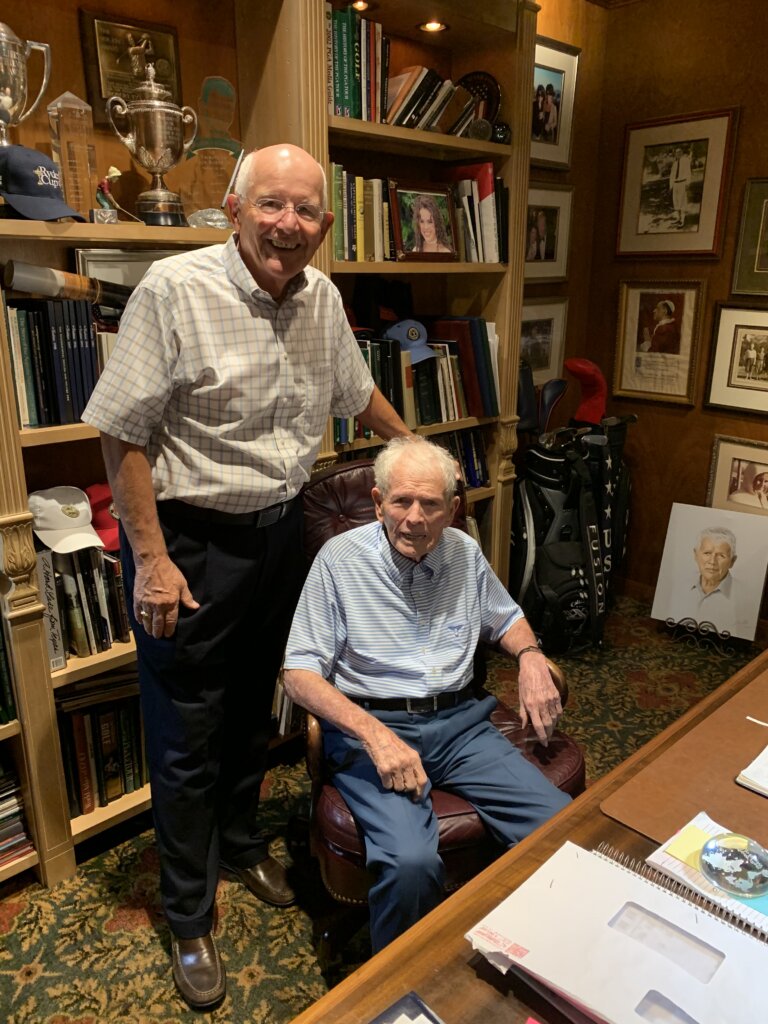
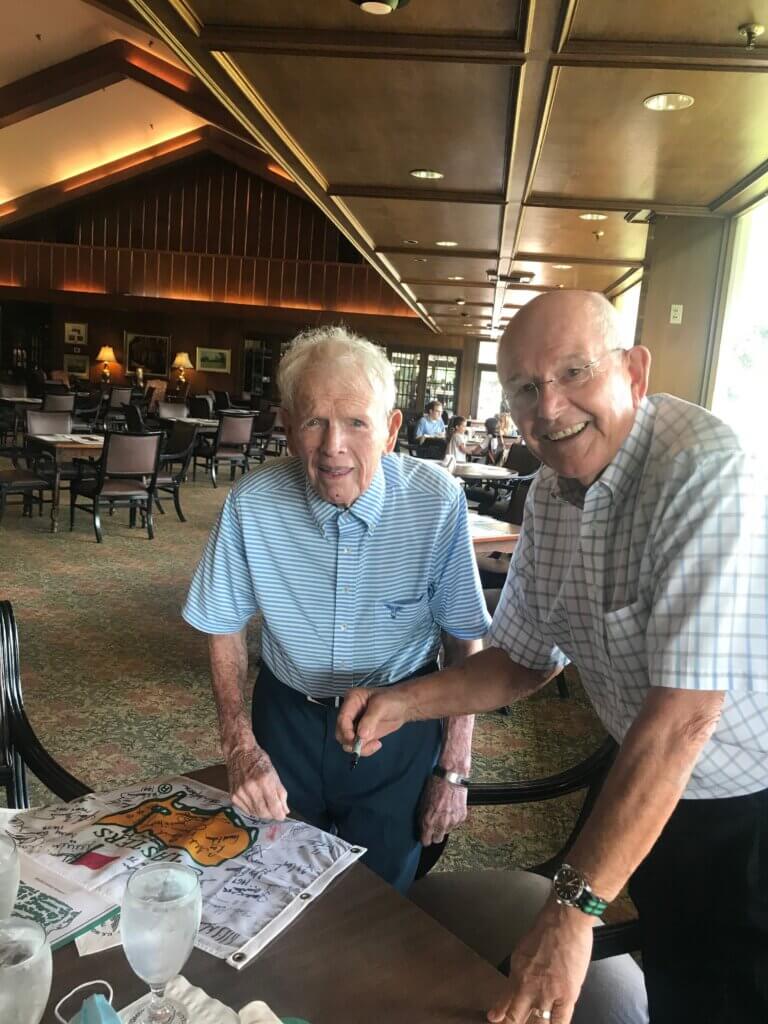
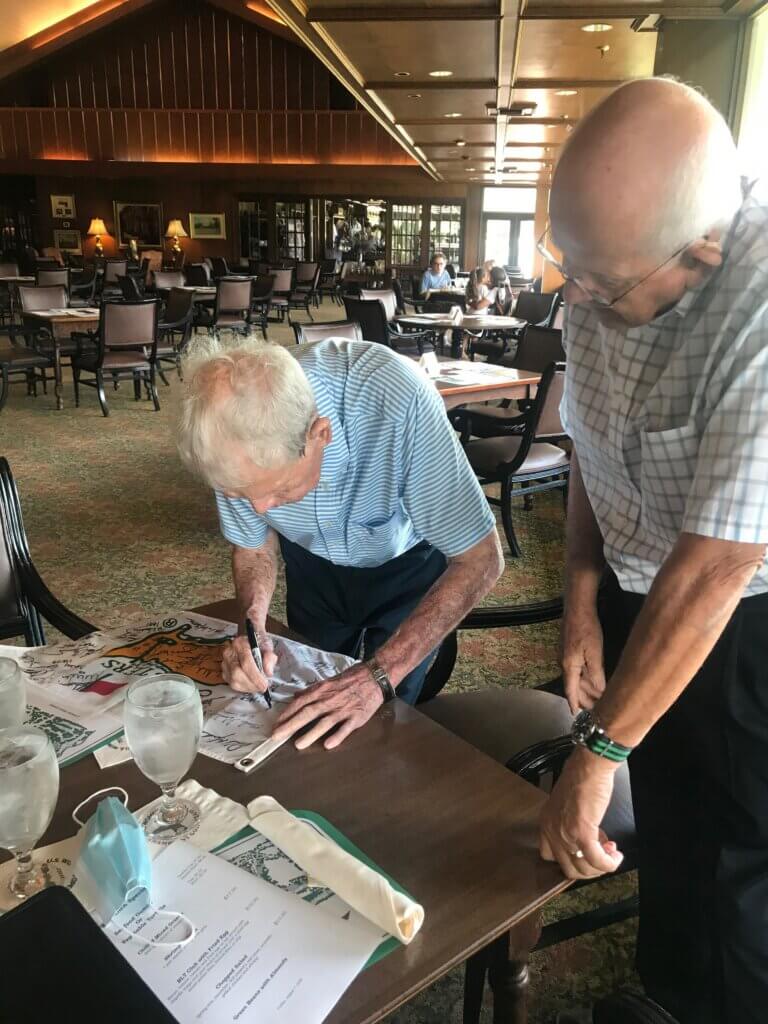
8/7/2020 — Jackie Burke was the 39th signature on the flag. We met at Mr. Burke’s club the Champions Golf Club, Houston Texas. Never in my wildest dreams did I think I would get a day like today to meet the oldest living Masters winner and the oldest living Major winner. This has been the most exciting day yet in my quest to sign all the Masters champions. Thanks to Charlie Epps, who was instrumental in getting the Angel Cabrera signature six months previously; I had the best day in hunting Masters winners yet. Charlie and I stayed in touch over the summer after previously asking him if he knew Jack Burke Jr, who is 97 years old and also lives in Houston. Charlie not only knows Mr. Burke; they are great friends and business associates from the past. Charlie told me in March that he would like to arrange our meeting this summer. Then the pandemic hit and I thought all bets were off. On about August 1st, I received a call from Charlie Epps and he said I was invited to have lunch with Jack (Jackie) Burke Jr. and Charlie at the Champions Golf Club in Houston. Mr. Burke not only owns the Champions Club, but at age 97, still goes to his office there every day. His wife Robin (much younger lady) drives him each day and he still directs a lot of traffic at the Club. Originally, Mr. Burke and Jimmy Demaret bought the property and built the course in 1957, the year after Jack won the Masters. Mr. Burke still plays a major role in the operations of Champions. Jack personally interviews each prospective member and nobody over a 15 handicap is allowed to join. He also has hosted the Champions Invitational for amateurs for many years and only those with a 3 handicap or better are invited. The Champions Course is the only golf course in America that will have hosted every major tournament after December 2020 when the U S Women’s Open is scheduled. My day started at 4:00am in getting up for a 6:30 flight to Houston. Charlie Epps picked me up at the airport about 10:30 and we drove to the Champions Golf Club to meet Jack Burke Jr. I don’t think I’ve ever met a man that is more intense about his love of the golf game. While having lunch, Jackie told so many stories about his golf career and the joys it brought him with friendships. He reminded us that his best friend was Bing Crosby and he met him because “he was one of the few movie stars that knew how to play the game right”. Jack is a very opinionated fella and says things like the “Rule Book has too many rules—should only be about 10”. And he can’t imagine why people are “paying $700 for each golf club and $300 for an hour lesson when, if they were any good; they could pick up any set of clubs in the store and hit ‘em well”. Jack Burke is adamant about the fact that “good amateur players don’t have enough good places to play” and that’s why he hosts the Champions Invitational each year.
After lunch, Charlie Epps and I were invited to take a ride around the Champions course with Jack. It was very apparent that all the members gave Jack the right to go wherever he chose as we did in fact, drive across some fairways while players were on them. When we got to the 18th tee box, Jack asked “Do you know what this is”? My answer was that it “appears to be the 18th hole”. Acknowledging my dumb answer, Jack told me it is the place where Ben Hogan took his last shot before retiring. I must admit that I was a little numb just thinking about that kind of history.
Finally, we returned to Mr. Burke’s office for a few photo ops. While I was standing off to the side of his desk admiring the Otey Crisman putter he used in the 1956 Masters; he asked me if I liked that putter. After acknowledging that I did; he insisted I have a replica of it while he signatures the shaft. To say that I was walking on cloud nine doesn’t properly express how great that moment really was.
A little bit about the Otey Crisman putter. When Jack Burke won the Masters in 1956, the win was one of four consecutive weeks in which he won a tournament that year. He also won the PGA the same year. During the following Masters (1957) 27 of the 83 players were using that same Otey Crisman putter. I’d say his wins with it were the best sales and marketing events ever. Otey Crisman is a company from Selma Alabama and still exists today. Otey III runs it now and my putter was made under his watch.