by Gary Williams | Apr 27, 2025 | Blog
Windows are a convenient metaphor for life and sports. In the broadest sense we are living in our own window of time and while the premise of where we are on our journey presumes how open or to what degree it may be closing is forever precarious. So much of where that metaphorical window is within the prism of a sports life is largely a physical proposition because historical actuary tables have always been a reliable guidebook. The physical being the greater indicator of how much longer because there are only so many hits a running back’s body can endure, how many more trips 94 feet for the knees of an NBA star and how many more 98 mph fastballs on the black for the arm of a major league pitcher. Too often the windows close so abruptly that the aging process appears in warp speed from one training camp to the next. But what of the mind? How can the intellectual and psychological elasticity of the mind elongate or shrink the sports windows of greatness?
I proceeded to call it Rory’s Rubicon five years into his quest for the career grand slam at The Masters which was also running concurrently with his pursuit of any major title. The longer it went the wider the mental river felt, and the psychological current was only getting stronger. He entered the space of four majors by 25 years of age in 2014 and pulled up a chair to a pristine tall top with two occupants, Jack Nicklaus and Tiger Woods. The presumption that his fifth would come fairly soon was not a cavalier position, it made sense, tons of sense. When it didn’t, he was not only distancing himself from Jack and Tiger, who went from four to five major victories in a year and a month respectively, he was methodically distancing himself from every historical player who reached at least five majors on the odometer. The average time taken to achieve the feat has been two and a half years. When he closed the book of a decade without a major victory at the site of his last, the 2014 PGA, he had also endured a flurry of gut-wrenching losses in 2022 at the Open Championship, the 2023 U.S. Open and the deepest cut, the 2024 U.S. Open at Pinehurst. As he entered 2025, he was embarking on year 11 without a major victory, the same gap of time that Tiger Woods experienced from the 2008 U.S. Open, major win number 14, and the 2019 Masters, the 15th and most certainly final major win of his mind-numbing career.
Tiger and Rory are different, in so many ways. However, the historical gap of almost the identical period of time between 14 and 15 for Tiger and 4 and 5 for Rory demands an examination. While much is not comparable the human condition is in play and that’s where we get to what now? Tiger was never someone to display or likely possess any self-consciousness on the golf course. First, what about his life in golf would have made him self-conscious? Self-assured? Check. Self-belief? Check, check. The most astonishing display of the power of his mind to refuse even a scintilla of self-consciousness was the 2010 Masters. Up until the end of the major championship season of 2009 he was throwing a perfect game of closing golf tournaments when he got himself out in front and then Y.E. Yang happened at Hazeltine in August of 2009 and his preposterous perfecto was broken up. It was going to be a historical footnote and then Thanksgiving happened, and he found himself on the back page of New York tabloids for three straight weeks. A golfer! Not Madonna, not Brittany, not Shia LaBeouf. Helicopter footage was more valuable than the yet to be relied upon pro tracer. When Tiger turned up at the 2010 Masters, he was even scolded by the chairman of Augusta National Golf Club. He finished 4th that week. 4th? Take your self-conscious dime store psychobabble and shove it. I know the category for greatest 4th place finishes in majors is not a big category, although the “No Laying Up” boys could somehow make it a four-part series and it would be compelling, and I would listen, but there’s no second or third place. Conversely, as Rory has been trying to walk through fire and broken glass to win any major, he consciously and comfortably has shared the psychological journey of self-examination, self-reflection while also clearly exhibiting with even some modest degree a level of fragility that it’s clear that self-consciousness is along for this turbulent yet rewarding pursuit.
This is where the road may fork, or maybe it won’t. Tiger’s climb to 15 in totality was much more about the physical than the mental, but it does factor. A decade of injury and surgery had compromised him to the role of spot starter, but 2018 was the big build to reentering the caldron starting with The Open Championship in July, the final round 64 to put his hot breath on the back of Brooks Koepka’s neck in August at the PGA and then win number 80 at the Tour Championship with a Bob Jones like 18th coronation at East Lake. Who was riding in the sidecar that day?Rory. He saw Tiger climb to “A” summit for the first time in years, not THE summit but one, nonetheless.
Climbing requires all athletes to get comfortable in the thinnest air and even though Tiger lived there comfortably for years it had been some time since he had completely outlasted all the others to plant his flag on the last hole. One additional footnote, right before Tiger showed up at the 2019 Masters, he clipped Rory at the now defunct match play in Austin. One more little piece of Kevlar to fortify Tiger’s mind and maybe debilitate Rory’s. Tiger’s march to major 15 was a gut-wrenching, gut check on every hole culminating with a wobbly 5 on the last to cross the tape AGAIN. He survived.
When Tiger completed the career grand slam at the Old Course in July of 2000 it was after he had already won majors by 12 and 15 shots. Nonetheless, many historians and intellectual golf observers believe his Open.
Championship win, major number four and the first of his three career grand slams was his Opus. All the way down to him calling shots with Steve Williams as he was picking out church spires in the town of St. Andrews and painting brush strokes with his fairway metals coming home on the inward nine at the Old Course. While Tiger’s completion of his first career slam was a virtuoso, Rory’s was a mash up of an episode of ‘MacGyver”, “Jackass”, “Survivor”, and ultimately the “Bourne Ultimatum”. But Rory’s fifth and his own slam possessed similar texture to Tiger’s 15th both after more than a decade without any. So, what now again?
Tiger was an old 43 in 2019, and Rory is an injury free, vibrant, sturdy and physically intact soon to be 36-year-old. But this now gets to the mind, the place Rory has done as much work as he has on his wedge play. The digs at Rory have endured whether he’s been privy to the extent of the noise about his inability to close majors over the past years or not. Here’s one thing he unequivocally is… aware. Even though he broke through his decade-long vortex to claim his green jacket, the circuitous, calamitous and dizzying way he got there has permitted a subtle uncurrent of cynicism to persist inside the golf ecosystem. Let’s extinguish that as best we can, knowing that cynics struggle to exist without cynicism pulsating through their veins. Few elite players have not voiced the unmatched pressure Rory was navigating and many believe no player has ever carried more into a final round in their lives and we could go further back but that’s sufficient enough context for now.
The Sunday duality of fatalism and heroism Rory displayed was exhausting and exhilarating. Each fragile moment was followed by an exhibition of big stinkin’ onions culminating with his second into the first playoff hole which followed Justin Rose applying ungodly heat on Rory to answer after his feeble five to finish regulation. Resilience doesn’t need a literary definition any longer in Webster’s it just needs a full-page fold-out of Rory on his knees on the 18th green after his long anguish-filled odyssey was over. Stoicism teaches that life should not be viewed as merely successes or failures but merely outcomes. The problem with that is that life is more fun only thinking about the good results. What’s fun about simulating failure? Rory has leaned on and been held upright by “the process” but even the sturdiest man would likely be crippled by the public de-boning and fileting Rory has suffered like a Dover sole most recently at Pinehurst last June.
The phrase it’s darkest before the dawn is poignant and practical and coined by Thomas Fuller in a poem in 1650. What wasn’t dark about the 1650’s? Rory reached his summit after being blown back to base camp with a kick to the teeth repeatedly. Each time, he persisted in beginning his ascent to that far off place, and in the case of Augusta National and his slam, a place no one has planted their career slam flag with all due respect to Gene Sarazen. Sarazen likely did not know he was in a playoff with Craig Wood until he finished that day in 1935 and really didn’t know what his win in the Augusta National Invitation meant until years and years later when the Masters was actually called The Masters and it was associated with the platinum quartet of golf’s greatest titles.
So, now that Rory has gone to that place where only five other men in the last 90 years speak the same language is he susceptible to what the human condition can do to all of us or is he liberated to pursue so much more now because he has been unshackled by what most have termed a burden for years now? The turnaround is swift. When the majors took on a new cadence starting in 2019, the year of Tiger’s 5th Masters title, it meant the majors would suffer no lag between major one and two each year. Four in four months and Tiger naturally was not equipped to begin another ascent so soon after breaking his own decade-plus long major drought at Bethpage. Brooks Koepka was amped to remind him that he had overcome his own 12th hole rinsing at Augusta in April of 2019 with an opening round 63 in the PGA with Tiger in his group. Rory will have his bounce because he was already arguably the biggest star who plays regularly and now he’s achieved something that many of the top players and the younger demographic who follow golf have never witnessed in their lives, a career grand slam.
He also returns to Quail Hollow which was the site of his first career PGA Tour title with a final round 62 in 2010 days before his 21st birthday. Since then, he’s added three additional wins at Quail Hollow including last year when he turned a two-shot deficit to Xander Schauffele on the 8th tee into a five-shot victory by undressing Quail’s inward nine. It’s his happiest haunt and his relationship with Quail Hollow extends beyond his mastery of the persistently changing golf course. It’s personal at Quail Hollow like it is for him at Augusta National. He has deep personal relationships at both places and actually attended the 2022 Presidents Cup incognito as an example of his affinity for the Harris family and the membership. Quail is simply what’s next and Oakmont and Royal Portrush make sense for Rory to contend but this is about much more than 2025.
Erosion is normally not something that gets your attention immediately. Over time you examine the way something once appeared and then years later it’s simply not the same. Complacency is similar. It’s subtle and only time will reveal the slightest easing off of one’s pursuit and the accompanying results that are marginally or dramatically impacted by the human condition. Achieve the greatest feats you possibly can especially if the pursuit is elongated, and it would be understandable if your mind found ways to rest. However, that arduous pursuit that hardened Rory McIlroy and taught him about how to find progress during moments of disappointment will likely override a sense of the job being completed. He’s always been a curious sort and it’s far more likely that his curiosity about what now will be the driving force for whatever is next.
by Gary Williams | Oct 6, 2024 | Blog
When the mind is quiet it is inclined to drift to the things that matter most. Those things are our people. The ones we love, the ones we’ve lost, the ones we choose to spend the most precious thing on…time. In September of 1995 I traveled to Scotland for the first time and did so with my dad. We returned in July of 2002, and on both occasions, we had the Muirfield day. Returning there again for the first time in 22 years with three dear friends in a head space with clarity and comfort made the conditions right for reflection and acceptance. Not your typical round of golf but rather an examination on the human condition.
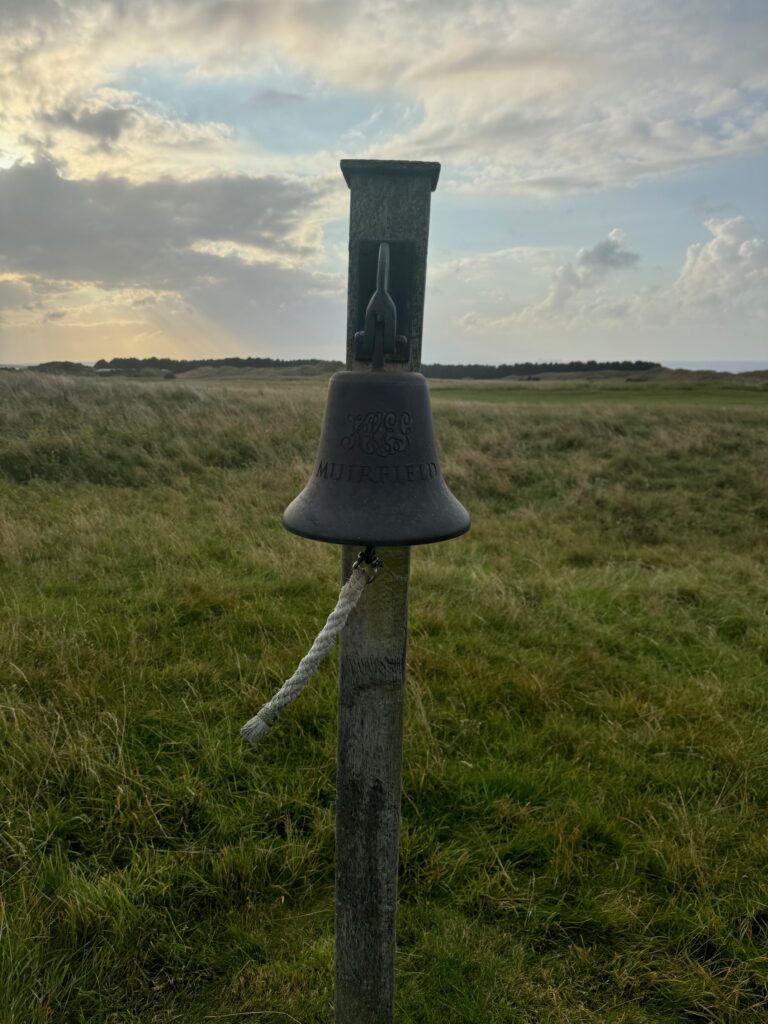 In a world that has gone casual, having a day at the gathering place for the Honorable Company of Edinburgh Golfers has become golf’s most refined and glutinous costume party. The tie has died but at Muirfield neckwear is not only fashionable, it’s required. Truth is, we all clean up pretty nicely we just don’t do it much anymore. Fleece is the new cashmere and hoodies are today’s double-breasted blazers. Rarely would you ever think a room ensconced in tweed would be a cool room and maybe it only is because we are at the best defacto “golf gala”. Seeing the giddiness on the faces of dozens of men coming off the 18th green at Muirfield knowing they are showering and putting on a coat and tie happily is counter intuitive to the way we sashay through life now. One of the top items sold in many of the finest golf clubs in America are logoed sweatpants. Sweatpants! Not your dad’s thick sweats from the local sporting goods store, but sweats, nonetheless. A spectacular item as I’m a card-carrying wearer of the soft bottoms.
At Muirfield you’re obligated to show a little respect. Respect for the place, for each other and for yourself. Among the other particulars of the Muirfield day is the requirement to play alternate shot in the afternoon after imbibing and ingesting enough food and drink to make a nap the most normal thing to do. That format gave me a cathartic moment in September of 1995, seeing my partner, my dad, hitting our tee shot on the 8th hole with his silhouette painted against the Firth of Forth in the background. Standing 200 yards down the fairway I felt a sense of love and appreciation for the man who raised me, guided me, and championed me without condition or reservation my entire life. Being present with clarity and good intentions has allowed me to achieve something altogether lost while in the throes of alcoholism. Stillness. The still mind creates the full heart and being back at Muirfield with friends who have known me since I was a teenage freshman at Vanderbilt was humbling.
The clockwise outward nine direction at Muirfield takes you from the northwestern portion of the property riding along the dunes recessed from the shoreline 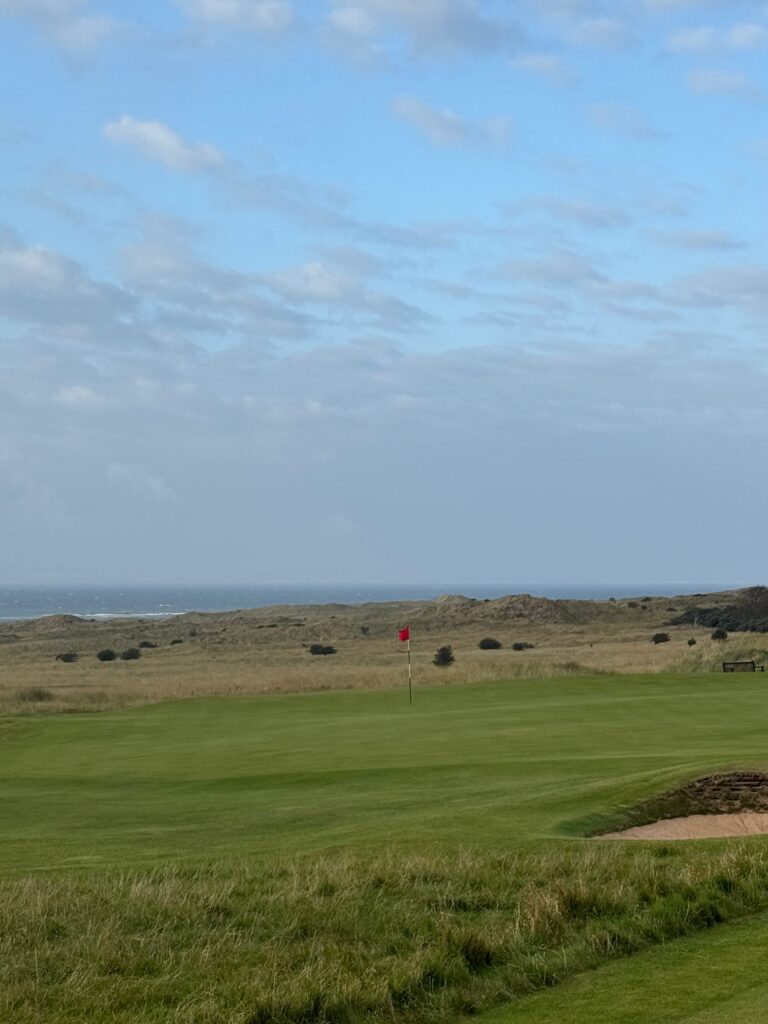 of the firth. From there, you play on the interior of the property in the counterclockwise direction meandering through the native fescues and re-vetted faced bunkers. Our Muirfield day was breezy and by late afternoon the low clouds were breaking away and the light on the golf course was illuminating the ground into a high-definition landscape. The shades of tan, brown, and green of the fescues and gorse offset by the churn of the blue and white of the distant sea created a transient texture. I never once consciously reminded myself of moments at Muirfield with Dad, it was simply happening. It was a flow state of gratitude and introspection and coupled with the continuous reaction of Lawrence, Bill, and Jay to the reveal of each hole was the summit of what the game can give. A trip to Scotland gives you an appreciation of each place, it’s history and the respect for certain traditions. It provides endearing fellowship, a little edge of a competition and a togetherness that comes from the pilgrimage to simple be there. In what area of your life do you devote countless hours to be in the company of others by your own choice? Not just the hours being on the golf course but every waking hour eating, talking, and laughing. I fell in love with golf because of my dad and the time afforded and it was seminal moments at places like Muirfield that reinforced my affection for the game. To return there with men who I’m exceedingly proud of for their boundless successes, starting with their families, and to share an appreciation for pictures on the walls, the carving stations at the lunch buffet, the clearing bell on the 11th hole, and the grand gathering room for a libation to cap the day.
I understand why people play favorites. It’s only natural to build proclivities for people and places and it’s why we choose to spend time with certain people and at certain places. For years I’ve resisted declaring which is my favorite golf course. I was never doing it to be cute or unwilling to make the declaration because it served any purpose. However, not long after we finished our round last Tuesday at Muirfield and we were gathering our belongings to head out into an increasingly colder Scottish evening I said to my guys, “this is my favorite course in the world”. The reasons are personal beyond the majesty of the holes, but isn’t our relationship with the game personal?

by Gary Williams | Aug 10, 2024 | Blog
There can be pride in association. In sports, venues are part of the dream. It’s not only who you want to compete against its also where. Elite golfers know how much of an affinity elite athletes have for the game of golf. Babe Ruth went to the 1929 U.S. Open at Winged Foot to watch Bobby Jones. Michael Jordan started attending Ryder Cups in 1997 in Spain when he was still the best basketball player in the world, and he’s been to every one of them since. When you live in the golf silo it’s not uncommon to get whisked away in the moment of golf’s big events and they are big relatively speaking. Pro golf is niche but so are most of the disciplines and sports showcased on the Olympic stage. The difference is that Olympic achievement in table tennis, judo, and volleyball are inarguably the zenith of accomplishment in those pursuits and in golf it’s not. It doesn’t mean the weightiness of Olympic medals in golf is modest, it simply means that time collaborates the gravity of the achievement.
Weirdly, as the proliferation of sports globally has created enormous wealth for athletes and valuations of sports franchises have exponentially increased the prism with which too many fans view achievements has shrunk. Winning division titles in college and professional football, basketball and baseball has been marginalized. Individual sports value most wins less, like tennis and golf and quantify the merits of athletes more and more on the most elusive titles. Majors and grand slams titles, not to mention Super Bowls and World Series titles separate the best into the most pristine category of athletic achievement but it shouldn’t be at the cost of so many important benchmarks. Golf’s modern grand slam was a quasi-marketing tool spontaneously ignited after Arnold Palmer won the U.S. Open in 1960 at Cherry Hills. The tired debate about whether the Players is the 5th major falls flat with that very narrative. It’s either a major or it isn’t. It’s not slotted as 3rd or 5th and its neither. It’s not a major, it’s the Players and it’s a huge notch.
It was a very different time when Gene Sarazen won the 1935 Masters, which wasn’t even called the Masters in 1935. Brandel Chamblee quipped years ago on his podcast with Jaime Diaz that Sarazen won what was akin to the Hero World Challenge. It wasn’t to diminish the win. It was an accurate opinion on the modesty of the accomplishment at that time. Like the Hero World Challenge conducted by Tiger Woods, the 1935 Augusta National Invitation Tournament was a gathering of Bob Jones’ friends. Time has been very kind to Sarazen because the Masters has become the most famous golf tournament in the world. He had no idea he had completed the career grand slam because there was no such thing, but retroactively, he joined that elusive club, and it doesn’t make the accomplishment less significant. It’s simply context of the achievement. Time is on the side of Olympic golf primarily because of the players. While they will not extoll the premise that a gold medal is equivalent to a major championship victory, they are all amplifying the enormity of the experience and its impact on them as athletes. So, while they can’t proclaim that winning a gold medal is the biggest thing in their sport like wrestlers, pole vaulters and equestrian riders do, they now are sharing what all Olympic athletes convey about getting to the Olympics. It’s the biggest sporting stage in the world, and for golfers, who are athletes, it’s an authentic validation of that fact.
Seeing table tennis players on the USA boat during the opening ceremony interfacing with Steph Curry was a sweet moment for those young female athletes who live an athletic life of relative anonymity, but it was also an illuminating moment for Steph in his first Olympics. Steph Curry knows the road to greatness can take many different paths and he’s aware of the razor thin margins that separate athletes in moments and over time so shaking the hand of fellow Americans competing in table tennis was also a sign of immense appreciation. Appreciation for the pursuit. Golfers are Olympic athletes and the crowds in Paris gave them a thorough and exhilarating appreciation of the Olympic stage. The refrain for a team component will grow louder and it should but golfers are experiencing what all Olympic athletes do, they are beaming with the pride of association. Olympic golfers are proclaiming the grandiosity of being a part of it. Scottie Scheffler’s tears were not over a FedEx Cup bonus, it was from the human condition of wearing a gold medal and hearing his national anthem. People who love professional golf know how damn hard it is just to make a living at it but too many of those same people pass over the various benchmarks in the sport to look almost exclusively at major totals. Yes, they separate players from awfully good to great but there is other bold type that players can put on their resumes of achievement. Olympic gold is one of them and keeping the company of the greatest athletes from all over the globe, some of whom came to watch the golf competition, is great for the game now and the weightiness of winning a medal is only going to grow.
by Gary Williams | Jul 16, 2024 | Blog
Feelings are not facts. But we consume sports at a time that “takes” and what used to simply be called opinions are flooding our collective zones of consciousness. Engagement farming is an insult to every farmer, living and dead. It’s certainly real and it’s certainly sad and even golf has become susceptible to dime store trolling for “likes” and attention. Rory McIlroy is a generational performer with one of the great lists of accomplishments in the history of the sport. Pre-LIV he was not perceived as a polarizing figure but his dogged pro PGA tour position upon the creation of LIV, which has subsequently cooled, coupled with his insistence to simultaneously and agonizingly contend at many of the major championships over that same time have made him golf’s every week needle mover. While Bryson DeChambeau and Scottie Scheffler have won majors in 2024, Rory makes the most people sit forward when he jumps on the screen. Which gets us to right now.
It wasn’t supposed to be this way. Rory’s sprint to three of the four major championships before the age of twenty-five not only got him a chair at a small table with Jack and Tiger, it naturally and not hyperbolically, ear marked him for eight majors ten years on from his last in August of 2014. Then golf happened. Not the same golf that happened to Tiger after June of 2008, or Arnie after April of 1964, or Greg Norman just whenever. Presumption in golf is more precarious than flop shots from tight lies after a night of transfusions. It seems unfathomable that ten years next month Rory punted Rickie Fowler and Phil Mickelson off the 18th green at Valhalla and appeared to usher in his own era, complete with the career grand slam at his doorstep at the entry of Magnolia Lane starting in 2015. It would be easier to explain if his major drought was a result of career crippling putter yips or full swings yips let alone a debilitating injury. On the contrary, he’s missed one major since his last major win, the 2015 Open, and he’s been the most consistent performer without a win in that time, racking up 21 Top Ten’s in 38 major starts. Additionally, he’s finished in the Top 5 11 times, and been runner up on four occasions. That last occasion was met with the Rory reflex to flee the scene at Pinehurst. It was fight and then it was flight. He’s incurred some deep cuts while also enjoying one of the most decorated careers of the past 50 years. Which makes Rory a riddle.
Who seems to have it all but leaves you wanting? Who has done so much yet it seems so incomplete? Who has been argued as the best at his best for a decade but hasn’t been the best even ONCE in a major in ten years? Rory. His current place historically is way outside the curve of all players who won at least five majors in his career in regard to how long it took them to click the odometer from four to five. Tiger went from four to five in one month, Gene Sarazen one month, Arnold Palmer nine months, Tom Watson nine months, Ben Hogan ten months and Jack Nicklaus one year. It took Sam Snead, Lee Trevino and Nick Faldo an unfathomable two years to go from four to five, Gary Player, Byron Nelson and Phil Mickelson an excruciating three years. Seve Ballesteros and Brooks Koepka went an unimaginable four years to cross from four to five major victories. Only Peter Thompson who won five Open Championships went longer than five years and that’s only because he chose to play in only three United States based majors between 1958 and 1965. Rory is trying to cross the widest Rubicon amplified by a psychological riptide never navigated by a historic player in his prime. Ernie Els and Raymond Floyd’s fourth major wins were curtain pulling encores. And here’s the kicker, he’s exceedingly normal. Which for all the swing breakdowns and lamenting of a poorly timed tepid putter the dime store psycho analysis of who he is might be why he finds himself in this weird historical space.
Rory reads. He’s affected and effected. As much as he tries to avoid indulging the content creators and ink-stained scribes, only a few left, he just can’t help himself. Being exceedingly normal also means you are prone to petulance, stubbornness, doubt and most importantly vulnerability. You think years and close calls when you know you are the top of the class does not harden those emotions and behaviors? You watch and follow sports long enough you start to feel things as they are happening. Momentum is an extraordinary phenomenon. I followed Rory every day of the U.S. Open and he was as close to complete for those four days as I’ve seen him under the most demanding conditions until he wasn’t. It was not the tee shot on 15 that was flighted too low for most analysts liking or the alarming short miss on 16. After grabbing a two-shot lead on 13 with back-to-back birdies he did something he had not done all week. His tee shot on 14 was quick and low left and I sensed something getting quickly weird. From that moment his decision making and execution got disorienting, and just flat off. Being self-conscious is also another very normal feeling. Some historic players have had a major or three kicked their way and maybe Rory will require a massive break to cross the line again but this pursuit which has included, to his great credit, a handful of heart wrenching results is not just in the recesses of his mind it’s at the forefront of everybody’s mind. Like I said, you get feelings. Patrick Mahomes felt completely inevitable last year and for the foreseeable future. Michael and Tiger were inevitable. Rory has felt on the wrong side of that equation and getting gutted wickedly seems to reinforce that feeling.
This week its neither the home of golf nor the home of American golf. Both being sites of recent Rory sudden morosity. The history of men’s major championship golf is marked by resounding triumph after heartbreaking defeats. Phil Mickelson got off the mat after the Merion U.S. Open and his multiple errant wedge shots to soar to victory at Muirfield a month later. Adam Scott was lifeless after his slow burn to defeat at St. George’s in 2012 only to be fitted for a green jacket in the next major the following spring at Augusta National. Rory is four rounds away from going into his 11th year between major victories. Oddly, his hero, Tiger Woods was facing that dynamic when he won the Masters in 2019. Tiger was rolling the odometer from 14 to 15, Rory is trying to progress from four to five. McIlroy is as complete a player as he’s been in his mind, and I agree with him. It’s not simply Bob Rotella self-talk, his arsenal of shots is robust. He also possesses something exceedingly valuable in any walk of life, gratitude. He’s not jaded or bitter, albeit in the moments after Bryson brushed in the winning putt at Pinehurst, he simply wasn’t prepared to process the loss publicly. He loves what he does, and it doesn’t guarantee results, but it makes for a healthier head space. Picking winners of golf tournaments is fun and frivolous. At times players are pricklier and more temperamental than 3-year old getting into the gate at Churchill Downs, but the human condition makes them more reliable. The vagaries of the draw, the funkiness and fantastic nature of links golf can make things appear more random, which is also why its beautiful. It’s always darkest before the dawn, Rory is going to win the Open. Remember what I told you about feelings.
by Gary Williams | Jun 16, 2024 | Blog
We all have moments in our lives that we point to as to why we made choices, took certain directions and plotted our own courses in life. As time passes those moments take on a significance that can make you wonder what life may have been like had they never occurred. I never interpreted the moments as forks in the road but more like bends that encouraged me to lean into people, places and things. I hit my first golf ball in the mountains of North Carolina at Boone Golf Club under the watchful eye of my dad. Forty years later April 11, 2011, my dad witnessed me hitting a golf ball for the last time on the 6th hole at Pinehurst No. 2. His life was rapidly and alarmingly coming to an end at the hands of something as hideous as it sounds, transitional renal pelvic cancer. Of all places our last experience together on a golf course would be at a place that means so much to me and meant so much to both of us.
I possessed the dexterity to do most everything as a kid and that was genetic. Dad was an elite collegiate baseball player at the University of Florida, and I got a healthy dose of what he was given. I liked all the sports, and the team competitions were to my liking, but golf gave me something the others didn’t. The game gave me him, uninterrupted, for hours on end and sometimes for days. It was our space and sharing the game and all it provides took us everywhere, together. We won a father son golf tournament at Pebble Beach in 1993, we got paired in the final round of another father-son in Ireland in the spring of 2001 with a dad and his son, who was the 199th pick in the NFL draft the previous year. The son would quarterback the New England Patriots to the Super Bowl the following season and the two fathers and sons would arrange golf in the ensuing years following Super Bowl parades. My first rounds at the Old Course, Pine Valley, Royal County Down, San Francisco Golf Club, and Pinehurst No. 2 were with dad.
I loved Pinehurst as a kid and attended Pinehurst golf camp when a very young Hank Haney was an instructor on the staff. July 4, 1983, I returned to my room in the Carolina Inn after a glorious day of instruction before embarking on some twilight golf to turn on the television in the infancy of ESPN to learn from Bob Ley that Dave Righetti had tossed a no hitter for the Yankees against the Red Sox. I proceeded to run up and down the hallway of Pinehurst’s historic hotel. When dad retired, my parents moved to Chapel Hill from northern New Jersey and playing No. 2 with dad on Christmas Eve became our new tradition. The drive from Chapel Hill on highway 15-501 was filled with conversations that covered the gamut. The sand hills at the holidays are particularly charming and sleepy especially on Christmas Eve. Seeing dad’s silhouette across the rugged terrain of No. 2 against the softer light of a late December day is indelible. After all the years, all the holes, all the rounds these days remained what they were from the outset, precious. No. 2 was our #1 at a time in my life when I was making real decisions about career and marriage. Two days before my wedding in Chapel Hill a group of us ran down to No. 2 and Peter Kiernan, a lifelong friend, made an albatross on the 10th hole. He lived in Manhattan, and I wanted to alert the New York Times of the deuce but Peter said no way since he was taking an extra day off from work just to play No. 2.
When I spoke the night before my wedding as I tried to explain the impact of experiencing love as an adult, I spoke about a day dad and I shared at Muirfield in September of 1994. The 36-hole extravaganza that one can experience at Muirfield is punctuated by the brisk alternate shot round in the afternoon. I was hitting our second shot on the 8th hole and as I looked back at the sight of my father set against the backdrop of the Firth of Forth, I experienced a sense of love and gratitude that was foreign to me as a 28-year-old man. Why then and why there? I’m certain that I was finding purpose and casting aside the numbed-up aspects of early adulthood. The game and that man had given me so much already in life that the confluence penetrated me beyond any prior experience, and it was the game that gave me him so significantly.
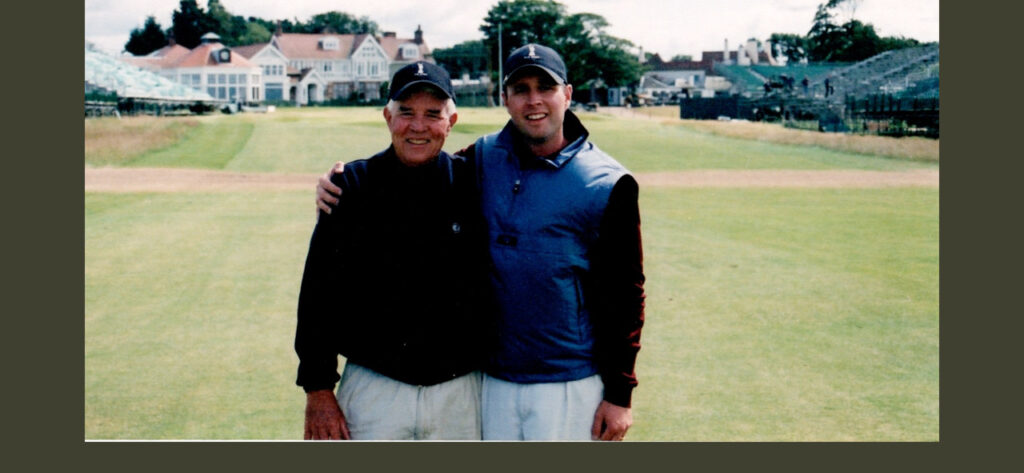
When I was asked to play with Ben Crenshaw in April of 2011 for the grand re-opening of No. 2 after the provocative restoration of the course by Bill Coore and Ben I was humbled. I aspired to cover sports for the performances not so much for the people. I have never professed to really know any of the athletes I have ever covered and it’s not that I know Ben particularly well, but he was the ONE. The only golfer, let alone athlete, that I lived and died with starting when I was seven years old. His major championship anguish was mine, his affinity for places like Crystal Downs and Palmetto Golf Club fueled mine. That April day in 2011 was too much for me. My dad had been diagnosed only three months earlier with stage 4 transitional renal pelvic cancer and his right kidney had been removed just four weeks earlier. He was terminal and a car ride to Pinehurst to see me play No. 2 with Ben Crenshaw was not reasonable, it was a borderline impossibility. But he did what he did for me, and my sisters are entire lives, he was there. The night before we had dinner in the Ryder Cup bar and he ordered a margarita and told the waiter, “Lets test out this one kidney”. He sat on a bench next to the 5th tee talking to Ben about mutual friends and the image overwhelmed me. My advocate and guiding light next to the only athlete I truly invested in emotionally in my life. A hole later dad was on his way back to Chapel Hill, the pain too extreme and three months to the day later he was gone. His last words on earth being, “I love you” to my mom, my sisters and me.
I am blessed to have great friends and many of those friends had a relationship with my dad. He possessed an extraordinary ability to identify the things that tickled people and he carved out very special relationships with my friend group. One of those friends in the last chapter of my dad’s life was Sean McDonough. Sean is one of the elite sports broadcasters of all time and he is also wickedly quick witted. Dad had great affection for Sean and when dad passed Sean was all too familiar with the loss having experienced his own father’s death, the legendary Will McDonough, a few years earlier. Sean said something to me upon my dad’s passing that in its delivery appeared harsh and unnecessary. He said, “Gary, it will never get easier”. Sean was preparing me for the agonizing reality that had become his own. It may have been the most truthful thing I’ve ever learned to understand. After all these years, 13 in July, it’s still right there. I don’t live life in sadness, on the contrary, I celebrate my dad’s life regularly, but his loss while living deep inside me is right under the surface. It blew a hole in me I will never fill and that is the cost of love. It’s simply the most profound loss in the human condition.
I never wanted to be my dad, I simply wanted to possess and exhibit so many of his qualities. My dad was not a public figure, but he was famous for his ability to allow people to feel their total worth. He was an only child but left the world with countless brothers and sisters because he found touch points that fostered deep relationships with people of all ages. He saw the game of golf as a beautiful metaphor for a good life, competition amongst friends. He loved a little action. Super Bowl weekend in Vegas, a triple crown horse race, The Masters Tournament, Dad loved to be in the mix because people were his oxygen. The last chapter of his life he was an admissions director at the Kenan Flagler School of Business at the University of North Carolina. The interview process for young professionals trying to gain admission into an elite MBA program can be stressful and dad’s interview style was unorthodox. His research was on the person. He knew the academic record was exemplary otherwise they wouldn’t be sitting there. Who are you and what do you love? How often are you ever asked two of the most important things? He knew one candidate had a baseball background and he started that interview by pulling a baseball from his desk and having the young man show him how he gripped the ball to throw his two seam, four seam, slider and curveball. That young man received his MBA for the University of North Carolina. Dad studied the stock market and charted countless trends, and I received cut out articles from the Wall Street journal almost every day in the mail regarding companies I worked for in my career like CBS, SiriusXM, and Comcast. But he made his biggest investment in other people to help them reach their greatest potential. I was not trying to satisfy him although any son wants their dad to be proud of them. I was seeking and pursuing achievement because he instilled in me an unwavering belief in myself. What a gift to bestow on others.
In July of 2019 I returned to Pinehurst for a few days to experience many of the new things that have been added since the last U.S. Open in 2014. The new dining experiences, the Cradle, the redone Pinehurst No. 4 and I stayed in Donald Ross’ home, the Dornoch cottage. I played with fathers and sons, fathers, grandfathers and grandsons. I took walks at sundown and at sunrise absorbing all of it with dad firmly in the center of my thoughts. I did not have envy or jealousy of any of the dads with their sons but rather a melancholy appreciation of what they were sharing. The game gave me the gift of time and it was bestowing the same on so many others, younger and some older than me. The U.S. Open has found a semi-permanent home at Pinehurst, and it will conclude on Father’s Day as it traditionally does. My first U.S Open was with dad in 1980 at Baltusrol. We saw Tom Weiskopf, newly enshrined in this year’s hall of fame class, shoot 63. Jack Nicklaus shot 63 several groups behind him. I saw Ben Crenshaw and Seve Ballesteros for the first time in person. We saw Tom Watson make a hole in one on the 4th hole on the lower course at Baltusrol. I was turned on to the game that week in a way that fueled my passion to make it a part of my life. All of it, however, was only memorable because I shared it with him. I still do.
Happy Fathers Day.
by Gary Williams | Jun 15, 2024 | Blog
It was a great tone setter for the day to meet up with Michael Campbell, the 2005 champion at Pinehurst. It was the first time back at Pinehurst since winning 19 years ago and he was dumbstruck by how different the golf course looked and the overall infrastructure of the championship. Campbell shared with me the details of his qualifying, which was the first year the USGA offered an international site. Michael lived 45 minutes from Walton Heath and even the convenience of being that close was almost not enough to get him there that day. The final hole of the 36-hole qualifier came down to a 10 foot birdie putt and his fellow competitor was just outside of his mark and Michael had to move his coin. Getting the read before he moved his coin back was the difference according to Michael and the closing birdie got him into the 2005 U.S. Open. Michael currently lives in Spain, loves his life and is loving being back at Pinehurst.
Following Rory McIlroy, Xander Schauffele and Scottie Scheffler first thing in the morning there were two things that were clear from their first hole, the par 5 10th. The greens were a foot faster, and Scottie Scheffler was playing from the fairway. Scheffler’s problem was the putter Friday where Thursday was about his inability to play from the fairway.
The experiment of putting the top 3 players in the world rankings together for the first two days has been met with mixed results of the players in the group. I’m a fan of the concept because this is an entertainment product and while you take the chance that they may not perform well together that’s a chance that applies to every group. Every grandstand starting on the 11th hole at 8 AM and all the way through their opening 9 was packed and the holes were lined three to five deep. Schauffele squandered a great scrambling round with the double bogey on the par 5 fifth hole. His demeanor is tremendous for major championship golf. Stay level and fight on every shot.
Rory McIlroy only made one birdie in his second round and gave back two shots to par but his 3 under that he posted by lunchtime gives him one of the final times on Saturday. The ball striking wasn’t as sharp as Thursday and he didn’t have the number of chances he had on day 1 but he accomplished what he needed to, a late tee time in round 3.
Bryson DeChambeau is flipping the script on his personal narrative. One, people are warming up to him, not everyone, but some people are changing their tune. Secondly, he scrambled his way to his second round 69. Not something many thought he could do at Pinehurst No. 2. It’s simple, he makes the big events more interesting. Bryson late on a Saturday at a baked-out U.S. Open site, sign me up.
Phil Mickelson got off to a horrendous start and labored his way to two dreadful rounds. The expectations of a man ready to celebrate his 54th birthday should be and are very modest but his place in the game right now is weird and him walking around Pinehurst 25 years after he contended for the first time in the U.S. Open wasn’t supposed to look and feel like this week did.
Thomas Detry is a really fine player, and this is not a surprise to me, and I mentioned him as guy who could contend on our U.S. Open preview show. He’s found his footing on the PGA Tour and Valhalla was a big step for him.
Ludvig Aberg would have been more of a favorite had he not been dealing with the lingering effects of a knee injury. His ability to adapt to new stages and big environments is only part of it. The severity and exacting nature of Augusta National and Pinehurst No. 2 only amplifies how good Ludvig is through the bag.
The evil pins on Friday were 1, 5, 10, and 15 and by the end of the day anything getting past 9 was going 30 yards down the hill beyond the green.
The golf course is in the total control of the USGA and they can soften it to what ever degree they want. My expectation is that they will provide a golf course with some modest opportunity tomorrow. I’m not a fan of them potentially moving the tee up on 13 and making it potentially drivable. I would like to see the two par 5’s be accessible with two great full shots and although there are not any real funneling pin locations on No. 2 they can be somewhat lenient. The ball is really flying in the hot temperatures and the ground is making this championship far more intriguing.
This is set up for a fascinating weekend.
Page 1 of 712345...»Last »
