by Gary Williams | Mar 30, 2023 | Blog
My first journey to the Sand Hills of Nebraska was twenty years in the making and I was only going to embark on the trek with my best friend in life. On the Sunday afternoon of our first day at the mecca built and designed by the team of Coore & Crenshaw we found ourselves sitting on Ben’s porch, affectionately named after one of the co-designers. The founder and visionary of the club, Dick Youngscap, had come out to the club that Sunday afternoon and he asked us to join him and his wife for lunch. Dick’s story and the construction of Sand Hills is a screenplay, and the 18-hole course signified a real change in the future of design and golf clubs. On 8,000 acres in what is truly the most fertile and holistic terrain I’d ever seen in the United States was 18 pristine holes. Among the many questions I asked Mr. Youngscap in that hour lunch was simply why not more holes. His answer, which I assume was not orchestrated or premeditated, was the most eloquent, colloquial and succinct response I had ever received from someone in my career. He started by asking me a question. “Gary, do you know what we do out here?” To which I responded, “no sir, I do not.”. He followed with, “Well, we are simple people, and we build fences. This is my land; this is your land and when I think about Yankee Stadium I think of four bases and when I think about the Boston Garden I think of two rims. Golf is 18 holes. Sand Hills is 18 holes.”
As we prepare for golf’s global renewal at Augusta National, I am reminded of the uncomplicated things, the proper things and the little things. Sand Hills was open almost 60 years after Augusta National, but it leans on the experience it provides and trusts that the things that were then, can still be valued now. Sand Hills could have 150 holes and a short course and posh cottages, but it doesn’t need it. Augusta National and the Masters could have television partners who would gladly show every shot struck from the ceremonial first tee shot to the last putt holed each day. The market for hospitality experiences for a small percentage of Masters partners led to the creation of Berckmans Place which is the most refined onsite, yet completely secluded, hospitality venue in golf history. Beyond that, everyone on the grounds essentially has the same experience down to the continued placement of lawn chairs around greens early in the morning. Lawn chairs? In 2023 the dignified placement of a 15-dollar lawn chair will ensure hundreds of people a seat to watch the most famous golf tournament in the world. It’s possible that concessions this year may challenge the long-standing theory that two beverages, two sandwiches and two bags of chips still produces change from a twenty-dollar bill. Even if it doesn’t, the simplicity of the transaction and the modesty of the tariff required for purchase makes it a relic in today’s high-end sports experiences. The U.S. Open tennis tournament is everything the Masters is not. Concessions that border on extortion and a viewing experience which feels disorienting from the noise to the behavior.
Stubbornness is a challenging quality to navigate be it with an individual or an organization and plenty of people may call Augusta National stubborn as it relates to the no cell phone policy on the property to the broadcast windows to the green jacket ceremony in Butler cabin. I heard for years that the broadcast times were to ensure that those on the grounds were getting something that the viewing audience could not get. If you put every shot on television what’s the motivation for those with badges to be on the property all day? Fair point, but the Masters created the finest digital experience well before their fellow major championships and it hasn’t deterred anyone from getting there early and staying late. The no cell phone policy is something that would truly keep many people from going to any sporting event, let alone a golf tournament, but Augusta National won’t cave to modern convenience. Can you imagine fans being told they could not bring their phones into the Super Bowl, The World Cup final or the Kentucky Derby? I know, golf is quiet, and silence is inherent to the execution of golf shots. Yet phones can be silenced, and all other golf tournaments permit them, but not Augusta National. Because the experience is supposed to be special, and it’s intended to be singular and different. We g
o through life telling others how great every moment is through text or Instagram while we are taking time away from that experience to talk about that experience. At the Masters, you walk with your head up, you watch golf shots not record them and then you talk about the shots you just witnessed with the people you are with. Yes, talk, and when you get home you don’t show people your pictures or videos you took while not watching golf, you talk to them about the shots you saw. Not to mention the people you ran into while you were there because your head was up, and you made eye contact. Yes, eye contact with an old friend as opposed to running into the sign indicating where Amen Corner is while trying to send a photo. It’s amazing how busy we all are that we must be on our phones every waking moment until the invite to the Masters comes and suddenly our pseudo oxygen supply can be cut off for eight hours. Not eight minutes, but an entire day.
In the fall of 1990, I was newly graduated from college and was going on a trip with my parents and we were sitting in the Newark airport when my Dad told me that he was taking me to the Masters the next spring. I cried. I wasn’t necessarily a grown man, but I was old enough that the news of attending a sporting event seven months in the future shouldn’t have reduced me to tears. I was emotionally and intellectually invested in golf in ways others weren’t but Augusta National and the Masters Tournament were mythical to me. I expected to be somewhat deflated because of the buildup, but I wasn’t. Hand-operated scoreboards, simple and economical concessions, grounds where the “Get in the Hole Guy” is an extinct species, and the view of Amen Corner from the top of the hill on 11 for the first time or the thirtieth is majestic. Way too much today is oversold and habitually under-delivers but the Masters still provides an experience that is not only redeemable but memorable. It holds tight to tradition while evolving in logistical and technological ways that are industry-defining, but they adhere to the little things that will always separate it from too many sporting events that have made staying home a bonafide option.
by Gary Williams | Mar 15, 2023 | Blog
Have you ever had a conversation with someone, and it was very clear that your opinions were divergent and reaching a common place was unlikely? It is usually during those moments that one or both of the impassioned voices will utter the most reliable and disingenuous disclaimer ever voiced, “With all due respect”. It’s these moments where civility and a modicum of respect for the other point of view are on life support. It is likely to be that time now in the industry of golf as the United States Golf Association and the Royal and Ancient have laid down their collective marker regarding their proposed answer to the ever-increasing distance in the game of golf at its highest levels. Where do we all go from here?
I’m not going to share the finite and technical details of the proposed modified local rule proposal right here because you can simply find those details anywhere and this is more about what now than what is it? The time it has taken to get to this place has been excruciating and for the governing bodies it’s been the white whale for decades. Governance is a thankless business and now more than ever, with blue check marks for sale, the opinions of the masses are weightier or at least louder. Change is discomforting and governing a game where scratch players think they can Monday qualify for tour events and grillroom legends think they have a vision for golf course design which would entice Dr. Mackenzie to want to pull up a chair to learn a thing or two about the craft, are plentiful. The game of golf is enjoying high times right now and naturally there were immediate outcries that now was not the time to make significant changes to the game, primarily at the elite level. That is one of too many lazy and half-cocked responses to the local rule proposal. Actually, there is no better time than right now to forge ahead with the changes because of what the future holds, and moreover, making any real change when times are bad generally reeks of desperation. This change for all the outcry is not about tomorrow. First off, it would not come into effect until January of 2026, but this change is as much about 2076 as it is about a couple years from now. The reactions from some would suggest the governing bodies are coming after their wallets and the truth is MANY who are invested in the game in different ways only see it that way. So, for any righteous indignation emoting from companies and individuals about the distance reduction ask yourself what is it that they have to lose? Maybe nothing, but to them they may have a very good thing going and they don’t want it to change. That’s not an unreasonable or unnatural reaction to have but it certainly doesn’t guarantee that they are actually thinking about the welfare of the game. Many simply are not. They are thinking about potential lost market share and for some of the elite players the potential loss of some competitive advantage. The game is inherently selfish, and I promise you many of the outcries I heard upon the release of this proposal are just that, selfish.
Bifurcation is an amazing word. No other 11 letter word sounds like a four-letter word to so many. It is now being weaponized by companies making equipment for all to use as the only thing that separates golf from dizzy bat. I’m sensitive to the cost associated with the research and development of an elite ball that would be required by all the manufacturers. I also recognize the economies of scale that are associated with mass production of balls used by all. However, there are several ball makers who already manufacture balls for a finite subset of the professional game. I also think there is merit to the ongoing premise that golf as a participatory sport makes the argument that we all play the same thing an argument with some merit. However, the rules that elite players abide by and the equipment that is built for them by the same manufacturing companies that consumers purchase from are barely recognizable to each other. Bifurcation has existed in golf for decades and decades and creating a local rule for the long-term betterment of the game for our grandchildren will not tear the game apart.
The challenge right now is to cut through the propaganda on both sides and get to the real issues and real concerns that are and will continue to be masked by players and equipment companies who will profess a commitment to and for the well-being of the game when in reality they care about their stock price and their bonus pools. Neither of which has to be affected at all starting in 2026.
Where do you think the cost of trying to keep up with the changes required in the game have been felt for the past 20 years? Not by the elite players who are making obscene amounts of money, not by the manufacturing companies who have been enjoying record profits but by the consumer who pays dues, initiation fees and green fees at every entry point of the game. Plus, the planned obsolescence when each club company rolls out a new driver that is longer every single year that you can’t live without. The thirst for more yardage, new tees, faster greens, which comes at an extraordinary price tag gets peddled onto the recreational golfer. Restoration and renovations are far outpacing new construction and these projects cost millions and millions per facility. So, this plea to not put the cost exclusively on the ball companies rings hollow. Assessments, initiation fees, monthly dues have all been exponentially increased as distance has continued to go up. Augusta National has deep pockets but they paid in the tens of millions for a strip of land owned by their next-door neighbor just to try to insure the viability of their most famous, amongst all of the famous holes, on their golf course.
As for the leading players in the game acting as if this is blasphemous, their words and their statements have little to no weight. Justin Thomas called the USGA selfish. This on the heels of the PGA Tour’s best players closing off most entry points to their biggest tournaments to ensure the continued gravy train of new cash in the system, produced in large measure from the existence and presence of LIV golf, going to a small pool of players. Any player who advanced the idea last summer in Delaware of turning the designated event series into a grab ass of 40 to 60 players needs to sit this conversation out. They were thinking only about themselves and their newfound leverage as a way to make more at the expense of the overwhelming majority of the tour’s membership and its future members. It’s hard to see beyond what something might mean other than what it means to you right now but that is exactly what this proposal is intended to do. This is not easy, and it will require a fair amount of forward and unselfish thinking. Many of the voices who can and are heard every day are paid messengers. For all the concern about not being able to play what the players play because they have so much influence over the recreational golfer, why have the equipment companies turned away from paying top players as much or as many to paying “influencers”… many of whom couldn’t break wind in a baked bean eating contest yet they have value now because their audiences are dedicated and have exhibited brand loyalty. I’m not sure of their feelings about a distance reduction but when and if I hear similar talking points that equipment manufacturers released after the announcement being regurgitated by paid messengers then those words are weaker than water.
Finally, this initiative was going to have to be taken on by some front person and in the case of the USGA its Mike Whan. Mike has a varied background which included a chapter in a marketing capacity. He will have to sell this to not only the invested golf companies and organizations who run elite golf events, but he will have to be accessible to the people who talk the game, many of whom will want a pound of flesh. Some people were cut out for certain jobs and Mike Whan is the right person to advance this because he’s pragmatic and a good communicator. The best communicators are great listeners and Whan is that, plus he is wired for performance without it feeling like it’s just for show. He will be equipped with all the data points, but his greatest strength is his willingness to not only see the other side but recognize the merits of the opposition to the proposal. I worry about the sustainability of not only the most cherished courses in the world but also the never-ending necessity to keep up. I want to see the examination of the best players be more thorough and that is also being compromised. Speed is a skill, and its refinement is jaw dropping and I do not want to see that severely diminished, and I do not think that will be the case as all early evidence is that the longest may experience an even greater reward than before. Those things are to be determined. Let’s all try to see beyond who gets affected most right now and I understand that is not normal in the human condition. Let’s also acknowledge the real concerns and challenges both sides of this argument have and listen to them without resorting to name calling. And if you are one to scream that amateurs with 15 handicaps shouldn’t be governing the game, please lose the lazy line or just sit this discussion out because these “amateurs” are devoting their lives to the game and study it every waking moment, from rules, to equipment testing standards to course and agronomic conditions. These are serious people making serious decisions. I support the distance reduction, but I want this conversation to be constructive and I will remember, like I hope you can, that reasonable minds can differ.
by Gary Williams | Mar 6, 2023 | Blog
Comparison is the thief of joy. And so why is so much of life spent doing just that? Bigger house, bigger car, bigger job, longer off the tee and so on. It’s a constant and what do we derive from all the comparisons other than envy and resentment? It’s not totally unhealthy or unconstructive to find measuring sticks because they can also serve to motivate and inspire. But the sports talk “gasbaggery” that permeates our world is continually and constantly polluted with comparisons of not just now, but of all time. These discussions parse everything down to who did what and where. The where is central to the weight of the discussion.
Since the Players Championship was born in 1974, and subsequently more so since it moved to its permanent home at the Stadium Course at the home of the PGA Tour, the event has grown in scope, size, purse, and stature. It’s a massive event and its enormity is only matched by a few events in the sport. But for many, it’s not enough. Some players, some media and some fans want it to be a major. It’s not, and that’s more than ok. It’s the crown jewel of the best tour in the world boasting a massive global reach across television and streaming audiences. It has an astronomical purse which outpaces the four majors by millions of dollars. It resides at a time on the calendar where the NBA season is crawling to its merciful regular season finish and is still almost three months from crowning a champion. Additionally, college basketball does not hold the place it once did with the sporting public other than the constant fever for legalized wagering. And finally, it is played on a golf course that is recognizable, that elicits opinion on its merits, and is home to one of the most provocative holes in golf, let alone championship golf, in the 17th. Add in the strength of field, which is void of qualifiers and amateurs, and it’s the sternest examination of global championship field depth in tournament golf. Despite all that, some want more. They want the MAJOR title.
The evolution of what we now consider the grand slam of golf took decades to be established. Amateur golf was the standard in the game and golf’s professional game didn’t become firmly entrenched until after Bobby Jones retirement in 1930. It took time for the Masters tournament to ascend from the perception of regal fellowship to a colossal achievement upon in winning.
As Brandel Chamblee expertly and snidely said a few years ago on his own podcast about Gene Sarazen completing the career grand slam at Augusta National in 1935, “What he won at that time was the equivalent of winning the Hero World Challenge”… the end of year boondoggle for less than 20 players put on by Tiger Woods. The four men’s majors have comfortably held that status for roughly 75 years and up until recently the advancement, albeit modest, to include the Players as a major was from only a handful of media members. The kingmakers of American sports journalism could share opinion, help drive initiatives and without arm-wrestling readers help them form their own thoughts on what was and wasn’t of real value in sports. The notion of bestowing major championship status on any event in golf, specifically the Players Championship, faces a brutally more demanding evaluation than it would have even ten years ago. The mass proliferation of digital media and the behemoth that is social media at large has given every solitary fan of golf their own digital voice for consent or dissent. And no, the idea of a fifth major is not only insulting, it’s harmful to the brand. Sports have fundamental and romantic connections to numerical value and distinction. The Grand Slam is FOUR yesterday, today and always.
The whataboutisms to senior golf and women’s golf are a waste of time. Senior golf is highly competitive, and they also drive carts. Women’s golf has faced countless challenges with far more majors that had the status and then didn’t exist, plus the decision to create a fifth major was to placate a sponsor. A couple years ago, in a joint meeting with the PGA Tour and management, production and on-air staff for Golf Channel, I asked Jay Monahan if he liked people in the golf industry advancing the idea of the Players as the fifth major. He said at that time it wasn’t something he could control but did I have a point with the question. I did. Why would anyone want to strive to be recognized as fifth in anything especially with the notion you are equal to the other four. You would either be a major or you would not be a major. It’s already established that people rank the weight of the four majors and inevitably the PGA Championship comes in fourth (except for winners of only the PGA and their families) but they are firmly entrenched at the table. Moreover, nobody looks at the total majors won by Nicklaus, Woods and Hogan and does anything other than count the total. Trying to shoehorn the Players into major championship status will never come at the expense of the existing majors. The riptide of opposition to the declaration of major status whether by a television partner of the tour, media members or by the tour itself would be so self-defeating it’s not worth the advancement. Many things have certainly changed in men’s professional golf in the last seven decades but the four biggest events in the game as the bedrock of historical achievement have not. Finally, the existence of LIV Golf has separated the majors from the rest of the men’s game as the last four locales where the very best players in the world compete. LIV is not going anywhere, and the absence, starting with the defending champion, in addition to a dozen, at minimum, players capable of contending makes the Players less in potential depth of field than it was only last year.
There has been too much of the diminishing of achievement in elite sports. I’ve always appreciated and found division titles, conference titles and accomplishments less than the ultimate trophy as bold type on anyone’s resume. Winning a Players Championship is a massive accomplishment. Bullying the general public into accepting that it is more than that is counter-productive and a fool’s errand. Golf’s newer wave of independent thinkers and content creators are bright and righteous, and they hold the attention of a wide swath of the viewing audience. Pushing the major agenda only distracts and decays the event on the platforms that are also earnestly invested in covering it. Let it be what is. It’s the best win of all the events the best tour runs. That’s pretty major without ever being a major.
by Gary Williams | Mar 2, 2023 | Blog
One of the great and valuable lessons in life is to learn from your mistakes. Repeating ill-fated plans or procedures is not only a clear sign of stubbornness, but it also strongly suggests that the most capable businesspeople may not be in charge. In a period of rapid and profound change on the PGA Tour, much of it was driven by the existence of LIV Golf. They have now decided what the future looks like, and it feels familiar and soft. The details of the structure of the new Designated Events are disappointing and it didn’t have to be this way.
For all the hand wringing and public sniping at and about Greg Norman by many top players in the world he has been the impetus for two significant shifts in men’s professional golf in the last 25 years. First, his desire to create a world tour in the late 90’s was squashed from within and from it came the World Golf Championship Series. It was more like the United States Golf Championship Series and another country to be named later. It produced the coming together of more top players beyond the four majors and a few other elite events, and re-introduced no cut events to men’s professional golf after they disappeared from the game almost altogether once television and Sunday finishes became the norm. There are still a few no cut events, mostly composed of very short fields, like the Tournament of Champions and the Tour Championship, and now with shorter fields in the FedEx Cup playoff events you can add them to the list. World Golf Championships were no cut events with smaller fields generally 78 players and the match play event was 64 players with a bracket that eventually eliminated the best Wednesday in golf. There is very little competition for that title but the jeopardy of 32 players being eliminated on the first day was great television. The problem that the tour and its sponsors argued is that stars were being bounced early more often than top-seeded teams coached by Rick Barnes. (Just a reminder to all you Tennessee fans that the reckoning is coming. It’s what Rick does.) So even the mildly confrontational match play event took on the softness of the other stroke events in the series. Furthermore, the small field, no cut formula that is being reported will be the construct of the designated events in 2024 and it smells all too similar to LIV Golf… minus the shotgun starts with optional transfusions and cargo shorts.
The Tour is at the mercy to a great degree to the wishes of their stars and their stars have the “hand”. As was famously said in an exchange between George Costanza and his girlfriend in an episode of Seinfeld as George was trying to display his power in the relationship. “But I have hand!!!” he pleaded. Her dismissive response was, “and you’re going to use it”. Not exactly the predicament the players face today. They truly control the direction of the tour because of all the leverage they’ve gained from the presence of LIV offers. But the players are missing part of the plot. Yes, people tune in for the stars and their engagement with each other propel the big interest in the sport. However, the sport will always need to keep the door open for the underdog. The underdog has always woven their own thread through the history of great moments, especially in the biggest events. When Max Homa won the Wells Fargo championship, and outplayed Rory McIlroy playing with him in 2019, he was ranked 417th in the world rankings. He would not be in the field under the new make-up of the designated events of which Wells Fargo is one this year. Homa is now a top 10 player in the world and the belief and sense of belonging started there. It’s not to say that his ascension would not have still happened, but that beginning was memorable because it was on a huge stage. Ultimately talent will never be denied if it is matched with commitment and drive but the realization on the biggest stages are what sports have always been about.
Stars deserve the most money and now more than ever the biggest stars and best players are getting paid the lion share of the purses all the way down to the Player Impact Program (PIP), which is a glorified Q rating with an algorithm. The PGA Tour is championship golf. They had the opportunity to split the difference between the frivolity of 54 holes, no cuts and shotguns and maintain the edge of bonafide fields with at least a hundred players and the jeopardy of a 36-hole cut. Instead, they’ve opted for, what at first blush, feels more like a cool speak-easy with a secret handshake and the top players get to play with the house’s chips.
by Gary Williams | Feb 7, 2023 | Blog
Enshrinement into any Hall of Fame requires a volume of achievement. Most accumulate the necessary statistics over a career that spans, if you’re lucky, a decade, to on very rare occasions, two decades. The Halls of Fame that celebrate the greats in the NBA, NFL, and MLB are reliant on a sensible voting body, and with the exception of time removed from the game, there is no baseline criteria for consideration. The World Golf Hall of Fame (WGHOF), which will soon be returning to Pinehurst, has changed criteria, voting bodies and gone from annual ceremonies to hosting once every couple years. The last and most recent decision is by far the most practical measure the hall has made in decades. The actuary tables of historic golf being played constantly reminds us that few truly distinguish themselves from their peer group to the degree that they become so distinctly deserving of Hall of Fame status in perpetuity. But for too long the WGHOF has been overlooking people who impact the game far more than the best players of their generation and it’s beyond time for these people to be recognized.
Since the first Hall of Fame class of 1974 there have been more than 30 individuals who have been enshrined who did not distinguish themselves by winning major championships and/or constructing a resume of individual achievement. Those people include, two presidents, administrators and tournament chairmen, ambassadors of the game, course designers and one clearly defined teacher. How is that possible in a sport for a lifetime in which the vast majority of the people who play do not play the game as a profession. Participation is the cornerstone of the industry, and it drives everything in the game, especially professional tournament golf. There is no Hall of Fame that should be identifying and enshrining more contributors than the World Golf Hall of Fame, and that’s why it’s beyond time for Butch Harmon, Mike Keiser and the design tandem of Bill Coore and Ben Crenshaw to receive the recognition. Ben is a member of the 2002 class as a player but there is no Coore without Crenshaw, and that distinction should be added to his plaque.
Mike Keiser was a very successful man in the greeting card industry before turning his attention to reimagining the public golf space which was uninspiring and idling when he turned it on its head with the creation of Bandon Dunes. Not only did Keiser bet on the remote Oregon coastline and its sandy soil he, more importantly, trusted the souls and sensibilities of golfers to value and invest in the journey. Bandon Dunes is mecca for men and women who want what Keiser was selling from the beginning, that it’s about golf. The food is fine, and the rooms are acceptable, but the golf inspires. It inspires tens of thousands each year to make the trek, but equally it has inspired other developers to create destinations that challenge the concept of the direct flight. Actually, many of Keiser’s properties would challenge the fortitude of Neal Page and Del Griffith, the characters made famous in planes, trains and automobiles. The singular purpose of the journey has created a whole new category of retail golf and Keiser is its godfather. He’s created jobs in remote and modest communities. He’s enhanced the profiles of a handful of course designers and helped spawn the next generation of design. He’s pumped up the travel segment of the industry but, most importantly, he’s insured the unbridled joy of experiential jobs for generations now and later. Oh, and he’s made it profitable. He’s driven a reverse engineering of a model that got sideways, and then just bad, with real estate taking the priority over the quality of the golf course. Design was not celebrated in the 60’s, 70’s and 80’s as much as it was tolerated. Keiser has been a king maker and if you want to gauge impact on the game in the last 20 years, I mean real impact, Keiser is at the top of the list.
Similarly to Mike Keiser, Bill Coore and Ben Crenshaw have redefined the golf design industry and their work is so lauded, and these two men are in such demand, they could, if they choose, work well into their 80’s. Any careful examination of the history of golf design in the United States will provide a handful of projects as the most significant for their originality, inspiration and impact on the game and the industry. Chief among the most important courses built in the last 30+ years, Sand Hills in Mullen, Nebraska was the true paradigm busting project that has driven growth and development well into the future. The story of Sand Hills is a screenplay waiting to be constructed. From the natural existence of countless holes to the physical challenge of development to the isolated location, it takes “Field of Dreams” to a different galaxy. It not only drove the private sector for private destination golf, but it also ushered in a return to a minimalist approach of golden age architecture where the course designer led with land use, not the developer. In 30 years Coore/Crenshaw have built courses that are recognized among the very best in the world. Additionally, their consequential renovations at places like Pinehurst #2, Maidstone, Old Town and Prairie Dunes have helped fuel a part of the design industry that sat dormant for decades.
Coore and Crenshaw take a level of personal responsibility with each project that is now being matched by this generation’s best designers. The decades of design decay ushered in a level of ennui amongst golf fans such that little discussion was conducted when new courses opened and the familiarity with the prolific designers of the 60’s, 70’s, and 80’s was effectively non- existent. Arnold Palmer and Jack Nicklaus were prolific designers, but the chatter was as much because they were Jack and Arnie as it was for the number of inspiring golf holes they designed. Coore and Crenshaw have threaded the needle with the uber wealthy benevolent dictator owner who all have the same goal, build the most memorable experience for their members and guests – not the best golf course, but the most memorable. That aspiration requires a commitment and care uncommon to the norm. Bill and Ben quibble over finite details and the most ordinary hump or rumple on a landscape. To them they are the stewards of the land, the preservation of contour is their charge, and the ultimate goal is their work should look as if it was there. We are living in a renaissance of golf course design. The leaders applying the sense and sensibility to the current trade are Coore and Crenshaw. Why wait? Enshrine them now.
Finally, it’s time for the WGHOF to right what has been a continual wrong for at least a decade. In the history of golf there are few families who have had a greater run of sustained importance and relevance in the game of golf than the Harmon family. Claude Harmon was the platinum standard of club professionals during a period of heightened awareness and reverence for the golf pro. Not only did Claude direct the golf programs at Seminole and Winged Foot, but he was also among the better players in what amounted to be a part time job of playing at the highest level. He won the 1948 masters by five shots and finished 3rd in four additional majors, including the 1959 US Open at his home club Winged Foot. Claude fathered four boys who all made their way into the golf business, first as aspiring players, and ultimately all four were among the finest club professionals and teachers in the game. Each would go on to work with major champions and FedEx Cup winners, but one became the teacher and coach to the very best in the game.
Butch Harmon could play. He could play well enough to win a satellite/opposite field event on the PGA Tour called the Broome County Open which was played opposite The Open Championship. Butch, like his father, had a keen eye for the golf swing and like his father he knew how to make the motor run for those he was entrusted with. In Claude’s case it was the mind manipulation of his four sons that included unrelenting mental challenges. With Butch it’s been with the best players the game has seen, with few exceptions over the past 30 plus years. Golf Channel was built and launched in 1995 when Greg Norman was the biggest star in the game. Butch helped refine a golf swing that was majestic, dynamic, and productive. In 1993, with an initial interlude in Houston, Butch and Tiger Woods began a working relationship that produced the most destructive stretch of golf ever produced in the professional game. That included a total reconstruction through Tiger’s second full year on the PGA Tour. In addition to Tiger, Butch would become the swing and de facto mind coach for Ernie Els, Fred Couples, Adam Scott and Phil Mickelson to name a few. He became a valuable voice globally in the game as a commentator on Sky Sports. In addition, he conducted golf schools for the well- heeled who spared no expense to find improvement and joy in the game. Harvey Penick was inducted into the World Golf Hall of Fame in 2002 and his enshrinement was celebrated overwhelmingly. There has never been a better, greater, or more successful instructor to the stars in the history of golf. Instruction is a driving force in the golf industry today, and top instructors are TV stars, pseudo-celebs and Butch Harmon is their godfather. 3-day, 5-day and month-long golf schools have been job creators and industry staples for decades. There is no greater metric to determine whether someone was a significant contributor in the game than to say emphatically he or she changed the game. Instruction and its impact on the millions of people who play the game recreationally and the best players who compete for trophies on the best tours has never had a bigger role. Butch Harmon has been a driving force coupled with unparalleled success with many of the greatest players the game has ever seen. The time is now for the World Golf Hall of Fame to recognize him with enshrinement in its next class.
Golf as an industry relies on people playing the game. No other sport mirrors the rules played by amateurs with the best in the world more closely than golf. Each market segment is either mildly or significantly impacted by the others. People’s enjoyment of the game through instruction and the experiences on the finest golf courses in the world drive the business of golf. Mike Keiser, Bill Coore and Ben Crenshaw and Butch Harmon have made the game better, more enjoyable, and more sustainable because of their contributions. Not for now, for always. They created opportunity, inspired others who wanted to pursue what they pursued, and opened doors for others to make careers in the game. The door should be opened for all of them to take their rightful place in the World Golf Hall of Fame.
by Gary Williams | Jan 30, 2023 | Blog
I didn’t start finding an affinity for golf because it was more fun than baseball, basketball and football – that would come later. I spent every day growing up with friends on the fields and courts of my youth. Daylight would give way to nighttime and only when others had to go home would my day of play end. I never wanted for company, or friends, to fill days and my time engaged in the sports I loved. I even pursued the solitary and lonely pursuit of competitive junior tennis. That was never going to be sustainable because, as comfortable as I may have been by myself growing up, I thirsted for the camaraderie and collective environment of team sports. So why golf? Unlike anything else I participated in, only the exercise of hitting balls or playing nine holes of golf gave me the time, connection, and affection of my Dad. I certainly wanted his approval, but most importantly I wanted his time.
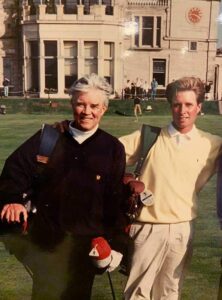 I learned how to have conversations with adults as a young teenager because my Dad exposed me to his network of personal and professional friends. My intuition told me the value of the game was far greater than the score I shot on a given day. I have no idea why I was able to make a fairly mature observation at a young age, but it never left me. At every phase and stage of my life and career the pull to play the game was keen and along the way I made connections with people who would frame and continually change my life. The man who was central in getting me an interview at Seminole Golf Club, Billy Armfield, was an advocate for me because we had spent time on the golf course at Greensboro Country Club. My best friend in life, Derrick Kraemer, was a beginner when I hired him as a cart boy shortly before his college graduation. Countless rounds over the next year, with his marked improvement, forged a relationship that has sustained itself through the decades as one of the most important of my life. Not long after I began my career doing local radio in Charlotte I was introduced to Jay Bilas, who has become one of the essential voices in sports television broadcasting. Jay came to the game later in his life but because of my morning schedule and his “summers off” from his work on college basketball we began playing a ton of golf together. His friendship, advice, and support over the last 25 years has been irreplaceable as I’ve made critical decisions about my career with his counsel being vital to my decision making. More recently, as I was getting close to concluding a decade of work at Golf Channel, Jaime Diaz was hired for his perspective on the game. My interludes with him through the years were always enjoyable but brief. When we began working together, I was presented with a true gift. Not just his thoughts and perspective on the game of golf as it related to our television work, but more importantly, his guidance and advice on life issues that were discussed constantly and continually on the golf course at the Winter Park 9. All of these are examples of the value the game has given to me through a life loving it, but it extends to something that is the most precious that I have that I was putting in jeopardy, my health.
 One of the tell-tale signs and behaviors of an alcoholic is the seeking and the pursuit of isolation. For me, it was the growing shame over being in the grips of alcohol, but it was also the simple need to be alone to drink the way only an alcoholic does. For all the years of joy and fond memories the game had given me with new and old friends, I had gotten to the point several years ago that I was willing to abandon and sacrifice all of them because the disease had taken hold of me. My job presented me with a fair amount of travel and there wasn’t a town in America that didn’t have a good golf course, and many were close to friends I made in and out of the game. Less and less did I make plans to meet friends, play golf, catch up on life and deposit valuable memories into my well-being. Instead, I consistently chose the loneliness and isolation of hotel rooms where I fed my disease and a growing strand of depression.
There are many signs of the insanity of alcoholism rooted in one’s behavior and many are simply too complicated to try to explain. For me to turn my back on wonderful experiences, likely on some fabulous courses with friends, amplifies the paralysis the disease inflicts on your heart and mind. If I did play, I was likely compromised before I showed up, limited my conversation, retained little and left many friends baffled by my aloofness. There was little to nothing redeemable about the experiences for all involved. It was only when I sought the help that I needed that the things in my life that mattered most started to be crystallized again. I am not suggesting that playing golf is among the most important things to me or my sobriety but the vital component of staying engaged with key people in your life is paramount.
 Once I started to reclaim some equilibrium in my life, golf resumed its place as a critical outlet for fellowship. Fellowship is at the center of my sober life, and now more than ever the redeemable aspects of spending time walking and talking with friends about the design features of the hole we are playing, the pedestrian quality of my ball-striking or the state of my sobriety are invaluable. It is critical that I stay engaged with others and for so many of my friends’ golf is what they invest time and money in for the exercise, mild competition, and the memories. Those things certainly apply to me, but my life is literally on the line every day if I am not committing to the essential elements of my sober lifestyle, and nothing is more important than engagement.
It would be dishonest and silly to say I got sober playing golf, but my sobriety is enhanced because I’ve returned to the places I found the most joy and discovered the greatest friendships, and many of them have been hatched or renewed by playing golf. In September of 2019, Derrick, my dearest friend, and I embarked on the journey to Sand Hills in Mullen, Nebraska. For decades we talked about the desire to eventually get there and with a clear mind and a healing heart I met Derrick in Denver and made the short flight to North Platte, Nebraska. The dingy motel room, the greasy burger at a local diner and the juvenile conversations for turning the lights out before heading to Sand Hills the next morning was the good stuff. These were not frivolous moments but precious and critical moments for me as the days were becoming shorter and my memory was becoming longer as I progressed in my recovery. We played 72 holes in 28 hours, ate pounds of red meat, and did what we always did, laugh at the little things and laugh harder at each other.
 More recently, I have taken upon myself to renew friendships with college buddies who I had not played golf with in 30 years. I thoroughly enjoy their company, but selfishly, I need their company. I recently had a conversation with the owner of one of the finest clubs in America and I asked him about the thing he gets the greatest joy from since opening his club several years ago. He told me for all the detailed analysis he did on his own about what he wanted the club to be he never estimated the sheer value of the time spent in “the room”. A term he affectionately calls the main gathering room in the clubhouse. “It’s the time” he told me that means the most to him.
As a boy I felt the importance and the love I had for my Dad through the time I got with him on the golf course, and now almost five decades later, I feel the love for the time with friends but also the absolute importance of that time on my ability to live a healthy and sober life.
Page 7 of 7« First«...34567
